Zepto vs Instamart: Which Quick-Commerce Platform Is Better for Brands?
Quick commerce has become an important growth channel for D2C, FMCG, beauty, personal care, food, and lifestyle brands in India. Customers increasingly expect everyday products to reach them within minutes, making platforms such as Zepto and Swiggy Instamart valuable channels for product discovery, sales, and repeat purchases.
But a common question for brands is: Zepto vs Instamart which platform is better?
The answer depends on your product category, target customers, geographic reach, inventory capabilities, pricing, and growth objectives. Instead of choosing a platform based only on popularity, brands should evaluate onboarding, product visibility, demand, inventory placement, advertising, margins, and long-term scalability.
Zepto vs Instamart: Quick Answer
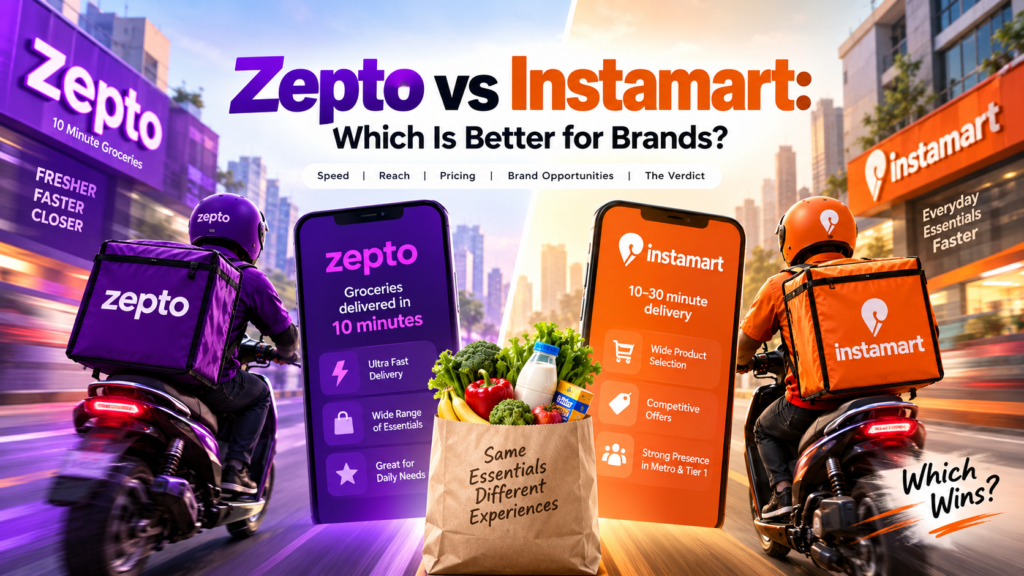
Zepto can be a strong choice for brands looking for quick-commerce-focused product discovery, rapid growth, and access to a broad category ecosystem. Instamart can be attractive for brands that want to leverage Swiggy’s existing consumer ecosystem and expand across multiple locations and categories.
For many brands, however, the best strategy is not choosing only one platform. A multi-platform quick-commerce strategy can help brands test demand, compare performance, and expand where products generate the strongest returns.
Zepto vs Instamart: Key Differences for Brands
| Factor | Zepto | Instamart |
| Platform focus | Quick-commerce focused | Part of the Swiggy ecosystem |
| Brand suitability | D2C, FMCG and emerging brands | FMCG, food, household and consumer brands |
| Product discovery | Strong quick-commerce environment | Benefits from Swiggy ecosystem |
| Inventory model | Dark-store based | Merchant/dark-store fulfilment |
| Advertising | Brand-funded promotional and advertising options | Promotional and advertising opportunities |
| Best approach | Start with high-potential SKUs | Test products across relevant locations |
| Growth strategy | Listing + visibility + inventory | Listing + demand + Swiggy ecosystem reach |
The exact commercial terms and operational requirements should always be confirmed with the respective platform before launching.
Why Brands Are Choosing Quick Commerce
Quick commerce is no longer limited to groceries. Platforms are expanding into beauty products, personal care, electronics, toys, home essentials, beverages, snacks, and other consumer categories.
Swiggy states that Instamart offers groceries and household products through merchant partners and dark stores. In 2026, Swiggy also announced Instamart’s expansion to more than 40,000 SKUs through conversational commerce integrations.
This creates an opportunity for brands to reach customers at the exact moment of purchase intent.
For example, a customer searching for protein bars, shampoo, cold drinks, baby products, or household essentials may make an immediate purchase rather than adding the product to a long-term shopping list.
Zepto for Brands: When Is It a Good Choice?
In the Zepto vs Instamart comparison, Zepto for brands can be particularly useful for businesses that want to establish a presence within a dedicated quick-commerce environment.
Zepto’s official onboarding portal currently promotes its brand ecosystem across multiple categories and provides a dedicated vendor portal for businesses.
Brands should consider Zepto when:
- Their products have strong impulse-purchase potential
- They can maintain consistent inventory
- Their pricing is competitive
- They have a focused range of high-performing SKUs
- They want to improve quick-commerce product visibility
- They are prepared to invest in promotions and advertising where appropriate
Zepto’s Brand Portal also supports functions such as purchase-order management, inventory tracking, invoice submission, and product-information updates. Brands that want to sell products on Zepto can start through this portal.
Instamart for Brands: When Is It a Good Choice?
Instamart for brands can be valuable for businesses looking to tap into the wider Swiggy ecosystem.
Instamart processes orders through merchant partners and dark stores, while Swiggy continues expanding its assortment beyond traditional grocery categories.
Instamart may be a good fit when:
- Your products have recurring purchase potential
- Your target audience already uses Swiggy
- You want to test multiple cities or regions
- Your category performs well in quick commerce
- You have sufficient stock to support local demand
- You want to build another digital retail channel
Brands that want to sell products on Instamart should focus on accurate product information, competitive pricing, strong images, appropriate category mapping, and reliable inventory availability.
Zepto vs Instamart: Which Is Better for D2C Brands?

There is no universal winner.
A new D2C brand should evaluate the platforms based on product-market fit rather than platform size alone.
For example, snacks, beverages, personal care products, beauty products, and convenience-led products may benefit from quick-commerce discovery and frequent purchases. Premium or niche products may require stronger product education, competitive pricing, and targeted visibility before generating consistent sales.
Your decision should therefore consider:
1. Product Category
Identify where your products have genuine quick-commerce demand. Products that solve an immediate need or encourage impulse purchases can have an advantage.
2. Inventory Availability
Quick commerce depends heavily on local stock availability. If your SKU is unavailable at the relevant dark store, customers cannot purchase it.
3. Pricing and Margins
Don’t evaluate sales without calculating net contribution margin. Consider platform commissions, promotions, advertising, fulfilment-related costs, discounts, and returns or adjustments where applicable.
4. Product Visibility
Being listed does not automatically mean being discovered.
Brands should optimize product titles, attributes, images, category mapping, pricing, and promotional strategy to improve product visibility on Zepto or Instamart.
5. Customer Demand
Monitor orders by city, SKU, category, conversion rate, repeat purchases, and inventory movement. The platform producing the strongest contribution not simply the highest order count may be the better channel.
Should Brands Sell on Both Zepto and Instamart?
For established brands, the choice to sell on Zepto and Instamart together can be a practical growth strategy.
Instead of treating them as competitors where only one can be selected, brands can use both channels to compare:
- Sales by SKU
- City-level demand
- Conversion rate
- Advertising performance
- Inventory movement
- Customer acquisition
- Repeat purchases
- Contribution margin
This data can reveal where your products have the strongest potential.
However, expanding across platforms without sufficient inventory or operational support can create stock-outs and inconsistent performance. Start with your highest-potential SKUs, measure results, and expand systematically.
How SalesStrive Helps Brands Grow on Zepto and Instamart
Managing quick-commerce accounts requires more than uploading products. Brands need onboarding, catalog optimization, keyword strategy, pricing, inventory monitoring, platform coordination, advertising, and performance analysis.
SalesStrive provides Quick Commerce Onboarding for platforms including Zepto and Swiggy Instamart, along with listing optimization, inventory planning, performance monitoring, and account support.
SalesStrive can help brands:
- Set up and coordinate seller onboarding
- Build optimized product catalogs
- Improve product discoverability
- Plan pricing and offers
- Monitor inventory and performance
- Coordinate platform-related issues
- Track sales and conversion metrics
- Build a scalable quick-commerce growth strategy
Conclusion
There is no single winner in the Zepto vs Instamart for brands debate. The right platform depends on your product, target audience, inventory, and sales goals.
With SalesStrive, brands that want to sell on Zepto and Instamart can get support for onboarding, product listing optimization, catalog management, inventory, and marketplace growth.
Ready to grow your brand on quick commerce? Connect with SalesStrive and start scaling your sales today.
Frequently Asked Questions
1.Is Zepto better than Instamart for brands?
Not always. The better platform depends on your product category, target audience, location, pricing, visibility, and overall profitability.
2.Can brands sell on Zepto and Instamart at the same time?
Yes. Brands can sell on both platforms to expand their reach, compare sales performance, and understand which platform works better for their products.
3.How can I sell products on Zepto?
Brands can start through Zepto’s official Brand Portal by completing the required business and compliance details. After onboarding, brands can manage their products and inventory.
4.How can I sell products on Instamart?
Brands can explore Instamart’s partner onboarding process. Category fit, product selection, inventory, operational readiness, and commercial terms can affect onboarding.
5.How can brands improve product visibility on Zepto and Instamart?
Optimize product titles, keywords, images, categories, pricing, and inventory. Promotions and regular performance tracking can also help improve visibility and sales.
6.Which is more profitable: Zepto or Instamart?
There is no fixed answer. Profitability depends on product margins, platform costs, advertising, promotions, order volume, and repeat purchases.
 hello@salesstrive.in