
How Swiggy Instamart Plans to Improve Margins Through Supply-Chain Efficiency
Introduction
Quick commerce is no longer only a race to deliver products faster. In 2026, the bigger challenge for platforms is how to make rapid delivery economically sustainable. Swiggy Instamart is responding to this challenge by focusing on inventory ownership, procurement efficiency, dark-store operations, and better unit economics.
The latest development is particularly significant. Swiggy is preparing to move Instamart toward an inventory-led model, allowing the business to purchase and own products directly rather than operating primarily as a marketplace. The proposed shift could give Instamart greater control over pricing, assortment, procurement, and product availability.
For brands, this evolution also matters. Understanding the Swiggy Instamart supply chain strategy can help businesses prepare for changing requirements around inventory, product availability, catalog management, and quick-commerce operations.
How Swiggy Instamart Supply Chain Works
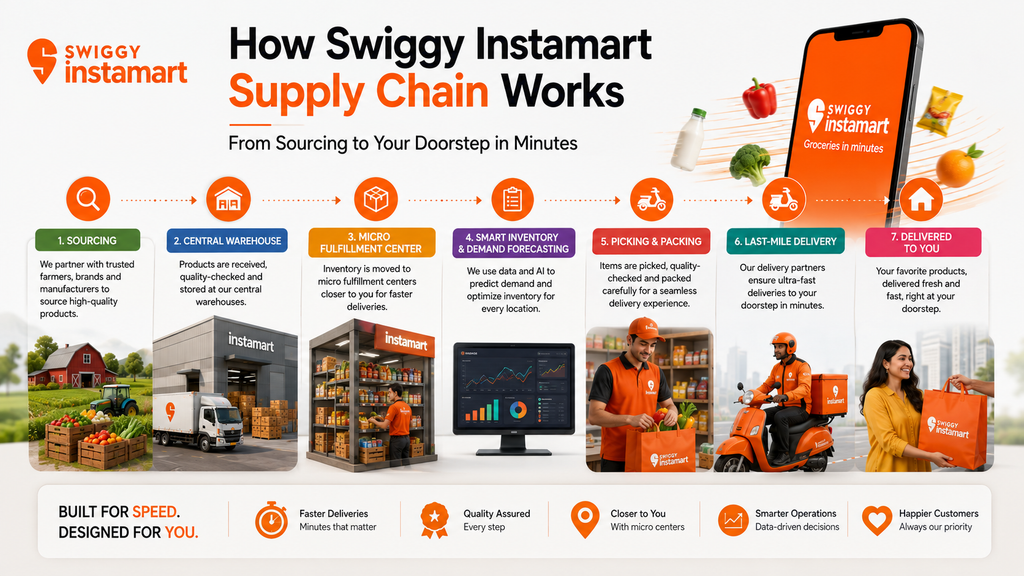
The Swiggy Instamart supply chain is built around a hyperlocal fulfillment model. Instead of shipping orders from large centralized warehouses, products are stocked closer to customers through strategically positioned dark stores.
These fulfillment locations maintain frequently purchased products so that an order can move quickly from inventory to the customer. Technology, real-time inventory management, order processing, and delivery routing work together to reduce fulfillment time.
A simplified Instamart supply-chain journey looks like this:
Demand Forecasting → Procurement → Dark Store Inventory → Order Processing → Picking & Packing → Last-Mile Delivery
Each stage affects the economics of the final order. Better inventory planning can reduce stockouts and unnecessary movement, while efficient fulfillment can lower operational costs.
Why Instamart Is Moving Toward an Inventory-Led Model
Since its launch, Instamart has largely operated through a marketplace approach. The proposed inventory-led model would allow Swiggy to purchase goods directly from brands and manufacturers, hold inventory, and sell products to customers.
This could provide greater control over pricing, product assortment, supply, and procurement. It may also strengthen Swiggy’s negotiating position with suppliers through larger purchasing volumes. Industry reports suggest that the model can improve procurement efficiency, reduce wastage, and strengthen relationships with brand partners.
However, inventory ownership also creates additional responsibility. Instamart must fund purchases, manage working capital, forecast demand accurately, and reduce the risk of unsold inventory. This makes the Swiggy Instamart inventory-led model an important step in its long-term business strategy.
How Supply-Chain Efficiency Can Improve Margins
The biggest question for quick-commerce companies is how Swiggy Instamart plans to improve margins while continuing to grow rapidly.
The answer lies in improving every stage of the supply chain.
By purchasing products directly, Instamart can negotiate better prices with suppliers, improve inventory availability, and reduce dependency on third-party sellers. Better procurement planning also helps lower sourcing costs.
At the operational level, efficient dark stores can process more orders with the same infrastructure. Higher order density, faster picking, optimized delivery routes, and accurate inventory management all contribute to improving Swiggy Instamart supply chain efficiency.
Analysts also believe that the inventory-led model could improve Instamart’s contribution margins by approximately ₹4–5 per order, making supply-chain optimization an important profitability driver.
The Role of Dark Stores and Inventory Management
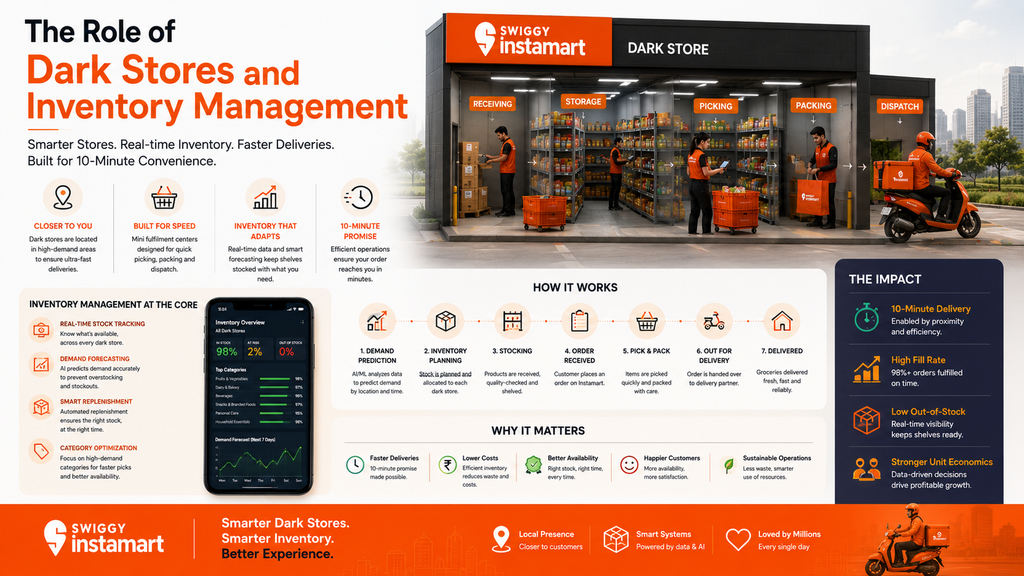
Dark stores are one of the biggest strengths of the Swiggy Instamart quick commerce model. These small fulfillment centers are designed exclusively for online orders and are located close to customer neighborhoods.
This hyperlocal network allows Instamart to deliver thousands of everyday products within minutes while maintaining better inventory control.
Effective Swiggy Instamart inventory management depends on several factors:
- Real-time inventory tracking
- Demand forecasting
- Fast-moving SKU management
- Automated replenishment planning
- Local stock availability
- Inventory turnover optimization
Instead of storing every product in every location, Instamart uses demand patterns to decide which products should be stocked in specific dark stores. This helps improve availability while reducing unnecessary inventory costs.
Lower Cost Per Order Can Strengthen Unit Economics
Quick-commerce profitability depends heavily on unit economics. Even if a platform receives millions of orders, profitability becomes difficult if the fulfillment cost of each order remains high.
Swiggy Instamart is focusing on improving:
- Procurement efficiency
- Inventory optimization
- Delivery infrastructure
- Revenue per order
- Cost per order
- Contribution margins
Reducing delivery costs, improving order density, and increasing operational efficiency can significantly improve long-term profitability. Better supply-chain planning also reduces stock wastage and improves inventory utilization across dark stores.
These improvements are essential for building a sustainable Swiggy Instamart profitability strategy instead of relying only on rapid expansion.
What This Means for FMCG and D2C Brands
The changing Swiggy Instamart business model creates new opportunities for FMCG brands, D2C businesses, and emerging consumer brands.
Instead of simply asking how to sell on Swiggy Instamart, brands should focus on building a stronger quick-commerce strategy.
Key areas that can improve performance include:
- Optimized product listings
- Accurate product catalogs
- Competitive pricing
- High-quality product images
- Consistent inventory availability
- Fast-moving product assortment
- Demand-based inventory planning
- Marketplace performance monitoring
For quick-commerce platforms, product visibility alone is not enough. Products must also remain available across local fulfillment centers to avoid missed sales opportunities.
How Brands Can Prepare for Instamart’s Next Phase
As Instamart expands its inventory-led approach, brands should prepare for a more data-driven marketplace environment.
Successful brands will increasingly focus on:
- Maintaining accurate inventory
- Understanding regional demand
- Managing fast-moving SKUs
- Improving product discoverability
- Coordinating supply with quick-commerce demand
- Monitoring marketplace performance regularly
Brands that invest in operational efficiency alongside marketing are more likely to perform well as the quick-commerce market becomes increasingly competitive.
FAQ:
1. How does Swiggy Instamart supply chain work?
Swiggy Instamart uses a hyperlocal fulfillment network with dark stores, real-time inventory management, and last-mile delivery to fulfill customer orders within minutes.
2. Why is Swiggy Instamart moving toward an inventory-led model?
The inventory-led model gives Instamart greater control over procurement, pricing, inventory, and product assortment, which can help improve operational efficiency and margins.
3. How can inventory ownership improve Instamart margins?
Direct inventory ownership allows better supplier negotiations, bulk procurement, improved inventory planning, and reduced operational costs, which can improve contribution margins.
4. How does Instamart manage inventory?
Instamart uses demand forecasting, SKU management, real-time inventory tracking, replenishment planning, and localized stock management across its dark-store network.
5. How can brands increase sales on Swiggy Instamart?
Brands can improve sales by optimizing product listings, maintaining inventory availability, using competitive pricing, managing fast-moving SKUs, and monitoring marketplace performance regularly.
6. Can SalesStrive help brands sell on Swiggy Instamart?
Yes. SalesStrive offers end-to-end support for Swiggy Instamart onboarding, seller account management, product listing, catalog management, inventory coordination, and quick-commerce growth strategies for brands across India.
Conclusion:
Swiggy Instamart’s evolving supply chain strategy shows that the future of quick commerce is about much more than fast delivery. Inventory ownership, procurement efficiency, dark-store operations, demand forecasting, and optimized fulfillment are becoming the key drivers of sustainable growth and better margins.
For brands, this shift creates a valuable opportunity to strengthen their quick-commerce presence. Businesses that maintain accurate product catalogs, consistent inventory availability, competitive pricing, and efficient marketplace operations will be better positioned to succeed on platforms like Swiggy Instamart.
At SalesStrive, we help brands simplify quick-commerce growth through Swiggy Instamart onboarding, product listing, catalog management, inventory coordination, marketplace management, and performance-driven growth strategies. Whether you’re launching a new FMCG brand or expanding your D2C business, our team helps you build a stronger presence across leading quick-commerce platforms.
If you’re planning to sell on Swiggy Instamart or improve your existing marketplace performance, SalesStrive can help you create a scalable strategy that supports visibility, inventory efficiency, and long-term sales growth.
 hello@salesstrive.in
3 Responses