How Swiggy Instamart Helps Local Brands Reach More Customers
Introduction
Quick commerce has changed the way Indian consumers shop for everyday products. Instead of visiting a supermarket or waiting for traditional e-commerce delivery, customers can now order groceries, snacks, beverages, personal care products, household essentials, and other products within minutes.
This shift is creating new opportunities for local FMCG brands, regional businesses, and D2C brands. Swiggy Instamart has expanded its assortment beyond traditional grocery products to include FMCG, D2C, and local brands based on city-level consumer preferences.
For local businesses, getting products onto a quick-commerce platform is not simply about adding another sales channel. It can help improve brand visibility, product discovery, customer acquisition, and regional market reach.
How Swiggy Instamart Helps Local Brands Reach More Customers
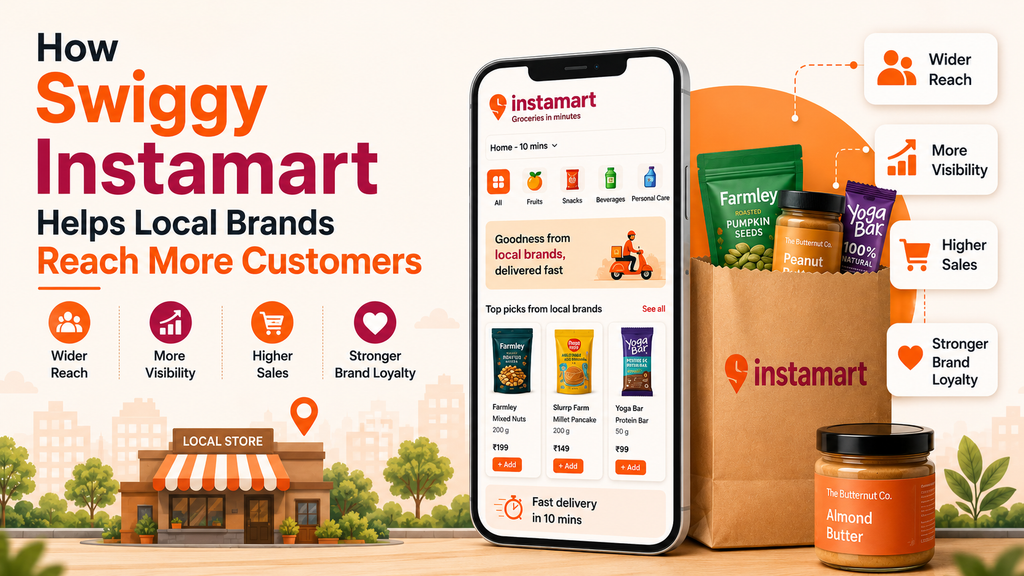
Swiggy Instamart provides local brands with an opportunity to participate in the growing quick commerce in India market. Its hyperlocal fulfilment model allows products to be positioned closer to consumers, helping brands serve customers who value convenience and fast delivery.
For small and regional brands, this can create a digital distribution channel alongside traditional retail.
1. Expands Brand Visibility
One of the biggest challenges faced by local brands is limited visibility.
A regional FMCG brand may have strong demand in a particular city or neighbourhood but struggle to reach consumers outside its traditional retail network. Being available on a recognised quick-commerce platform can expose products to customers who may not have encountered the brand through offline stores.
Swiggy Instamart brand visibility can be particularly valuable for emerging products because customers can discover them while searching or browsing relevant categories.
Instead of depending entirely on physical retailers, brands can use quick commerce as another route to reach potential customers.
2. Helps Brands Reach City-Level Demand
Consumer preferences vary significantly between cities and regions.
A product that performs well in Chennai may not necessarily have the same demand in Delhi, Bengaluru, or Jaipur. Local brands often have an advantage because they understand regional tastes, consumption habits, and purchasing behaviour.
Swiggy Instamart’s approach to local assortment allows brands to address city-level consumer demand.
This creates opportunities for: Regional food brands, Local beverage companies, D2C businesses, Bakery and packaged-food brand, Personal-care brand, Household product manufacturers
For many businesses, starting with a strong regional market can be a more practical growth strategy than immediately trying to compete nationally.
3. Improves Product Discovery
Quick commerce has changed the way consumers discover products.
Customers may open an app looking for a specific product, but they can also browse categories and discover new brands. This makes Swiggy Instamart product listing an important part of marketplace performance.
A well-prepared product listing should provide clear and useful information such as: Product name, Brand name, Pack size, Product variant, Price, Key benefits, Product images, Relevant product attributes
Clear product information reduces confusion and helps customers make faster purchasing decisions.
For local brands, effective product presentation can make a significant difference when competing with established FMCG companies.
4. Supports Hyperlocal Distribution Through Dark Stores
The dark store network is an important part of the quick-commerce business model.
Dark stores are fulfilment locations designed to store products closer to customers. This enables quick-commerce platforms to process and fulfil orders efficiently within specific geographic areas.
For brands, this means products can be made available closer to local consumer demand.
However, availability is critical.
If a product frequently goes out of stock, potential sales can be lost. Therefore, brands need to monitor inventory availability, replenishment, demand patterns, and fast-moving SKUs.
A successful quick-commerce strategy should therefore combine marketplace visibility with strong supply and inventory management.
5. Helps Small Brands Acquire New Customers
Customer acquisition is often one of the biggest challenges for small businesses.
Local brands may have loyal customers but limited opportunities to introduce their products to new audiences. Quick commerce can provide an additional digital distribution channel without requiring the brand to build its own delivery infrastructure.
This is particularly useful for products that customers frequently purchase for immediate consumption or daily use.
Examples include: Snacks, Beverages, Grocery product, Personal-care products, Household essentials, Bakery products, Daily-use FMCG products
As quick commerce expands into more cities, local brands can use these platforms to build a broader customer base.
How Local Brands Can Sell on Swiggy Instamart
Brands searching for how local brands can sell on Swiggy Instamart should first understand the onboarding and operational requirements.
Getting listed requires more than having a product ready for sale. Brands should prepare their business information, product catalogue, pricing, product details, compliance documents, and supply capabilities.
What Brands Should Prepare Before Onboarding
Before starting Swiggy Instamart seller onboarding, prepare:
1. Business and tax-related documentation
2. Complete product catalogue
3. Product images
4. Product names and descriptions
5. Pricing information
6. Pack sizes and variants
7. Relevant compliance details
8. Inventory and supply capabilities
9. Brand information
10. City-wise distribution capability
Having these details ready can make the onboarding process more organised.
How to List Products on Swiggy Instamart
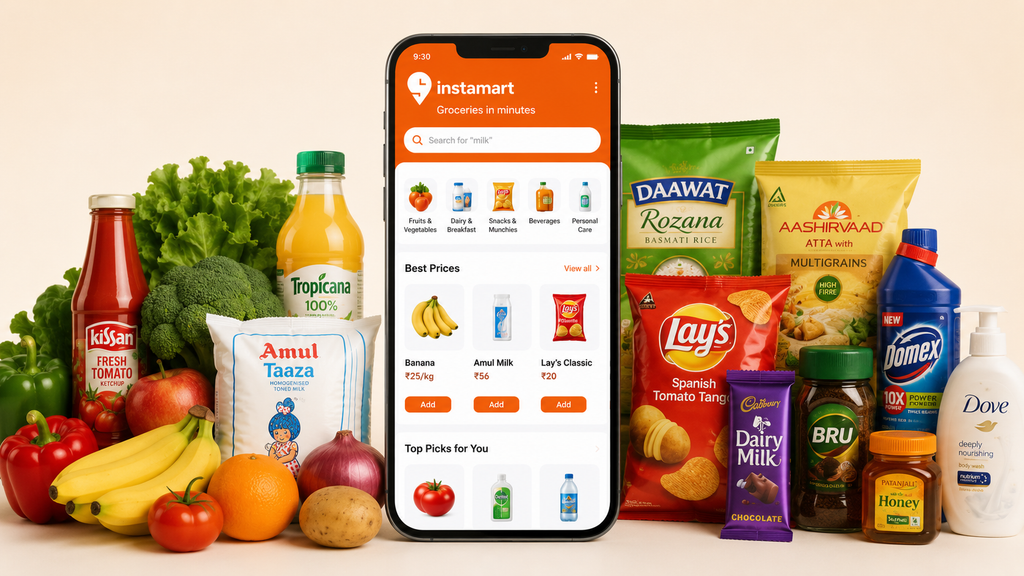
The process of how to list products on Swiggy Instamart depends on the platform’s onboarding and category requirements.
Generally, brands need to submit their business and product information through the relevant partner process. After the brand and products are approved, the assortment can be made available to customers in eligible locations.
However, simply getting a listing approved should not be considered the end goal.
Brands should continuously evaluate their product assortment, availability, pricing, visibility, and sales performance.
How to Increase Sales on Swiggy Instamart
Getting products listed is only the first step. Brands need an ongoing Swiggy Instamart growth strategy to improve sales.
Focus on High-Potential Products
Instead of immediately listing every SKU, identify products that have strong demand potential.
Products with: High repeat-purchase potential, Competitive pricing, Strong margins ,Easy-to-understand benefits, Suitable pack sizes can be prioritised.
Maintain Consistent Inventory
Product availability directly affects sales opportunities.
If customers repeatedly find a product unavailable, they may choose a competitor instead. Brands should therefore coordinate inventory planning with expected demand and replenishment requirements.
Optimise Product Information
Product titles, images, descriptions, pack sizes, and other information should be accurate and easy to understand.
Good product presentation can reduce purchase hesitation and improve the overall customer experience.
Analyse City-Level Performance
Not every SKU will perform equally across locations.
Brands should monitor Swiggy Instamart sales by city or fulfilment area where possible. This can help identify high-performing markets and determine where additional inventory or promotional activity may be worthwhile.
Why Professional Marketplace Management Matters
Managing a quick-commerce marketplace requires coordination across multiple areas.
A brand may need to handle:
· Seller onboarding
· Product catalogue management
· Listing optimisation
· Inventory coordination
· Marketplace operations
· Sales monitoring
· Promotional planning
· Performance analysis
For a growing business, handling all these activities internally can consume considerable time and resources.
This is where an experienced marketplace management partner can add value.
How SalesStrive Helps Local Brands Grow
SalesStrive helps businesses build a structured approach to e-commerce and marketplace growth.
For local FMCG brands, D2C businesses, and regional companies, SalesStrive can support areas such as marketplace onboarding, product listing management, catalogue optimisation, marketplace operations, and performance-focused growth strategies.
Instead of treating quick commerce as a one-time listing exercise, brands can develop a long-term strategy focused on visibility, availability, customer acquisition, and sales growth.
Whether you are exploring Swiggy Instamart onboarding for small brands or planning to expand across multiple marketplaces, having the right operational support can make the process more efficient.
Frequently Asked Questions
1. How can local brands sell on Swiggy Instamart?
Local brands can explore the Swiggy Instamart partner onboarding process and submit the required business and product information. Brands should have their catalogue, documentation, pricing, and supply capabilities ready before applying.
2. How can I get my local brand products on Swiggy Instamart?
Start by preparing your business documents, product catalogue, product images, pricing, and inventory information. Then proceed through the relevant Instamart brand or seller onboarding route.
3. Can small FMCG brands sell on Swiggy Instamart?
Yes. Swiggy Instamart has expanded its assortment to include FMCG, D2C, and local brands, creating opportunities for emerging and regional businesses.
4. How does Swiggy Instamart help local brands grow?
It can help local brands improve digital visibility, reach new customers, access hyperlocal demand, and distribute products through a quick-commerce fulfilment network.
5. How can brands increase sales on Swiggy Instamart?
Brands should focus on the right SKUs, competitive pricing, accurate product listings, consistent inventory availability, and ongoing performance monitoring. Understanding city-level demand can also help improve product assortment.
6. Is Swiggy Instamart suitable for D2C brands?
Yes. D2C brands in India can use quick commerce as an additional distribution channel to reach customers who prefer convenient and fast delivery. It can complement a brand’s own website and traditional e-commerce marketplaces.
Conclusion
Quick commerce is becoming an important part of India’s digital retail ecosystem, and local brands have a significant opportunity to participate in this growth.
For regional FMCG businesses and D2C companies, Swiggy Instamart can provide an additional route to customer acquisition, product discovery, hyperlocal distribution, and customer base expansion.
However, success does not come simply from getting listed. Brands need the right products, accurate listings, consistent inventory, strong marketplace operations, and continuous performance optimisation.
If you are looking for how to sell FMCG products on Swiggy Instamart or want to expand your local brand through quick commerce, SalesStrive can help you build, manage, and optimise a structured marketplace growth strategy—from product listing and marketplace management to improving visibility and sales performance.
 hello@salesstrive.in
3 Responses