Introduction
Quick commerce FMCG India is changing how brands sell, as consumers increasingly prioritise convenience, product availability, and faster delivery. From packaged snacks and beverages to personal care and household essentials, purchasing everyday products has become easier with the rise of quick commerce platforms.
Platforms such as Blinkit, Zepto, and Swiggy Instamart are changing how consumers discover products, compare brands, and make purchasing decisions. For FMCG businesses, this shift creates opportunities to reach new customers, strengthen digital visibility, and explore additional sales channels.
For FMCG businesses, quick commerce is more than another sales channel. It requires a different approach to inventory planning, product listings, pricing, advertising, and profitability.
In this guide, we explore how quick commerce FMCG India is transforming the market and the strategies brands can use to build sustainable growth.
What Is Quick Commerce in India?
Quick commerce, also known as Q-commerce, is a retail model designed to deliver groceries, FMCG products, and everyday essentials within a short delivery window. It typically uses strategically located fulfilment centres, often called dark stores, to serve customers in nearby areas.
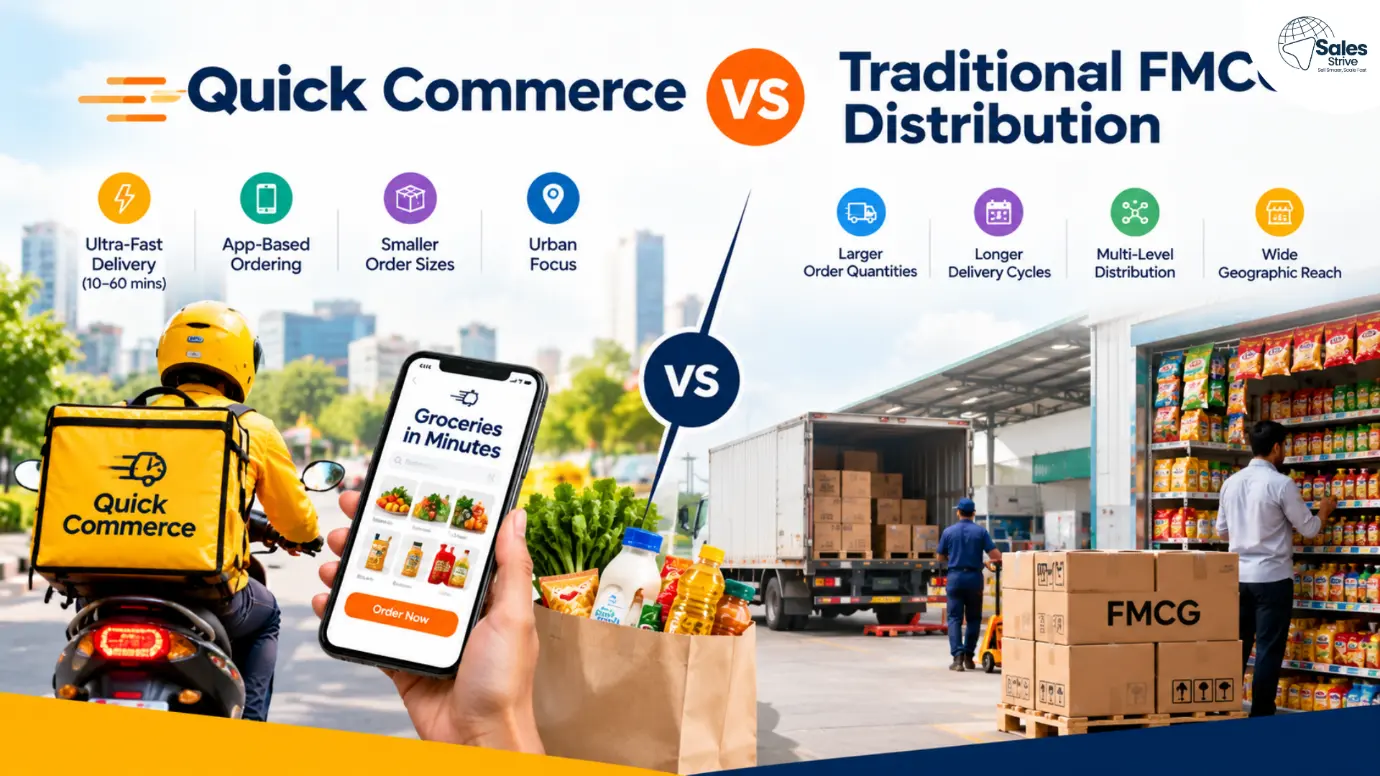
Unlike traditional e-commerce, which may involve longer delivery windows, quick commerce focuses on convenience and rapid fulfilment for eligible products and locations.
In India, platforms such as Blinkit, Zepto, and Swiggy Instamart allow customers to browse digital catalogues and order a wide range of products through mobile applications.
For FMCG brands, this model creates an additional route to market. Businesses can explore new customer segments, improve digital product discovery, and evaluate sales performance through platform data where available.
How Are Quick Commerce Platforms Transforming India's FMCG Market?
1. Changing Consumer Buying Behaviour
Consumers increasingly value convenience when purchasing everyday essentials. Instead of planning every shopping trip, they can order products whenever a need arises.
This behaviour benefits categories such as packaged foods, snacks, beverages, personal care, and household products.
FMCG brands must understand local preferences, purchase frequency, and product demand to identify the right products for quick commerce platforms.
2. Expanding FMCG Distribution
Traditional distribution depends on manufacturers, distributors, wholesalers, and retailers. Quick commerce introduces another route through which brands can reach consumers.
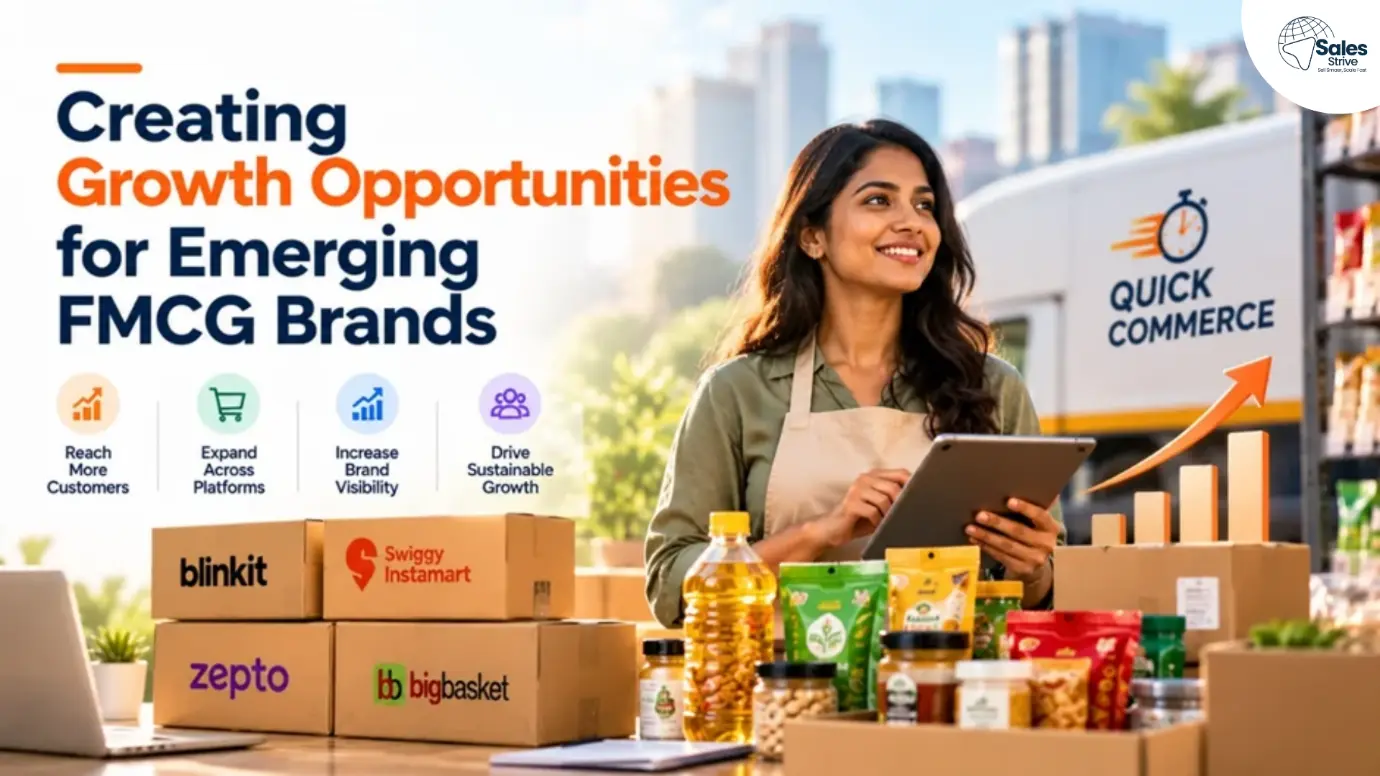
Businesses can use platforms such as Blinkit, Zepto, and Swiggy Instamart to expand their digital presence, subject to platform approval and operational availability.
However, successful FMCG distribution in India requires more than product listing. Brands must coordinate inventory, fulfilment locations, replenishment, and demand forecasting to maintain consistent product availability.
3. Improving Digital Product Visibility
Consumers often discover products through search results, category pages, recommendations, and promotional placements within quick commerce applications.
This makes product listing quality an important part of an FMCG growth strategy.
Brands should focus on:
- Relevant product titles and search keywords.
- Clear product images and accurate pack sizes.
- Complete descriptions and product information.
- Competitive pricing and appropriate offers.
- Consistent stock availability.
Better listings can help customers understand products and make purchasing decisions more easily. Actual visibility also depends on platform algorithms, competition, advertising, and local stock availability.
4. Creating New Advertising Opportunities
Quick commerce platforms provide advertising opportunities that allow brands to promote products closer to the point of purchase.
Depending on platform availability, these may include sponsored product placements, search advertising, banners, and promotional campaigns.
However, advertising should be evaluated alongside product costs, platform charges, discounts, and fulfilment expenses.
Brands should monitor impressions, clicks, conversion rates, advertising spend, and return on ad spend (ROAS). This helps them understand whether increased visibility is translating into profitable sales.
5. Making Inventory Management More Important
Quick commerce depends on having products available near customers. Poor inventory planning can lead to stockouts, missed orders, excess inventory, and wasted advertising expenditure.
FMCG brands should monitor SKU-level sales, location-wise demand, replenishment schedules, and seasonal fluctuations.
For example, a packaged snack brand preparing for a festive period should estimate demand, coordinate inventory with relevant fulfilment locations, and verify availability before launching promotional campaigns.
Effective inventory planning helps brands balance product availability with operational costs.
6. Increasing Competition Among FMCG Brands
Quick commerce offers new growth opportunities, but it also increases competition for digital shelf space.
Established brands may benefit from stronger brand recognition, while emerging businesses must differentiate their products through pricing, packaging, quality, and clear positioning.
Brands should identify their strongest products, analyse customer demand, and expand based on actual performance instead of investing heavily in every SKU from the beginning.
5 Strategies for FMCG Brands to Grow on Quick Commerce Platforms
Follow these strategies to grow in quick commerce FMCG India and improve marketplace performance.
- Choose the right products: Prioritise products with clear customer demand, suitable pack sizes, and sustainable margins.
- Optimise product listings: Improve product titles, images, descriptions, and relevant keywords to support product discovery and conversion.
- Maintain inventory availability: Coordinate replenishment and monitor stock across relevant fulfilment locations to reduce missed sales.
- Use advertising strategically: Test suitable campaigns, review ROAS, and avoid spending on products that are unavailable or unable to generate profitable sales.
- Track performance regularly: Review sales, conversion rates, inventory, discounts, advertising costs, and contribution margins to identify improvement opportunities.
Quick Commerce vs Traditional FMCG Retail
|
Factor |
Quick Commerce |
Traditional Retail |
|
Shopping method |
Mobile applications |
Physical stores and distributors |
|
Delivery |
Rapid, local fulfilment |
Store purchase or scheduled distribution |
|
Product discovery |
Digital search and app placements |
Shelves, displays, and recommendations |
|
Inventory |
Local fulfilment centres |
Retail outlets, warehouses, and distributors |
|
Marketing |
Digital promotions and in-app advertising |
In-store promotions and trade marketing |
|
Performance tracking |
Digital sales and campaign metrics |
Retail sales and distribution reports |
Both channels serve important roles in quick commerce FMCG India. A combined distribution strategy can help FMCG brands reach different customer groups and reduce dependence on a single sales channel.
Quick Commerce Calculator for FMCG Brands
A Quick Commerce Calculator helps FMCG brands estimate profit by considering product costs, platform fees, advertising expenses, and other operational costs.
Profit = Total Revenue − Total Costs
Using this calculator, brands in quick commerce FMCG India can evaluate profit margins, optimise pricing, and make informed decisions before expanding on platforms like Blinkit, Zepto, and Swiggy Instamart.
How SalesStrive Helps FMCG Brands Grow
Managing quick commerce operations requires coordination across onboarding, product listings, inventory planning, advertising, and performance tracking. Without a clear strategy, brands may struggle to improve visibility or understand why sales are not growing.
SalesStrive provides ecommerce marketplace account management, keyword research, listing optimisation, advertising management, and performance-focused growth support.
For brands entering quick commerce FMCG India, the first step is to understand product readiness, marketplace requirements, current performance, and growth opportunities.
Frequently Asked Questions
Everything you need to know about quick commerce FMCG India growth.
everyday essentials by offering rapid delivery, convenient
ordering, and digital product discovery.
platforms in India. Brands should evaluate product categories,
onboarding requirements, commercial terms, and geographic
availability before choosing a platform.
channels, promotional opportunities, improved product discovery,
and potential repeat purchases.
products, run targeted advertising, and monitor conversion rates
and profitability.
advertising costs, stockouts, demand forecasting, and
inventory coordination.
research, listing optimisation, advertising management,
and marketplace growth strategies.
Ready to Grow Your FMCG Brand on Quick Commerce?
From product selection and listing optimisation to inventory planning and advertising, SalesStrive helps FMCG brands strengthen their presence on Blinkit, Zepto, and Swiggy Instamart.
 hello@salesstrive.in

Your Trusted Marketplace Growth Partner
Get Your FREE Quick-Commerce Consultation Today!
Amazon | Flipkart | Myntra | Ajio | Meesho | Blinkit | Zepto | Noon | Walmart