How Blinkit’s Dark Store Model Enables 10-Minute Delivery
Introduction
Imagine ordering groceries, snacks, personal-care products, or household essentials and receiving them within minutes. This convenience has become a defining feature of quick commerce in India, and Blinkit is one of the platforms that has helped make rapid delivery a mainstream expectation.
But how does the Blinkit dark store model make such fast delivery possible?
The answer is not simply a large number of delivery riders. Behind the customer-facing app is a carefully designed Blinkit dark store model that brings inventory closer to consumers, uses local demand data, and streamlines every step between order placement and doorstep delivery.
Unlike traditional warehouses that may serve a large geographic area, dark stores function as compact, technology-enabled fulfillment locations positioned close to customers. This hyperlocal approach reduces the distance between products and buyers and gives Blinkit the operational foundation required for fast delivery.
What Is the Blinkit Dark Store Model?
A dark store is essentially a fulfillment center designed for online orders rather than walk-in customers. Products are stored, organized, picked, packed, and dispatched from these locations.
The key difference is location and purpose.
A conventional warehouse may prioritize large-scale storage and distribution. A dark store prioritizes speed, inventory availability, and local order fulfillment.
Blinkit uses this model as part of its hyperlocal delivery network. Dark stores are positioned within urban neighborhoods so that a customer can be served from a nearby fulfillment point rather than from a distant distribution center. Industry sources describe these locations as serving relatively small geographic areas, commonly around a few kilometers.
This makes the Blinkit delivery model fundamentally different from conventional e-commerce.
How Blinkit Delivers in 10 Minutes
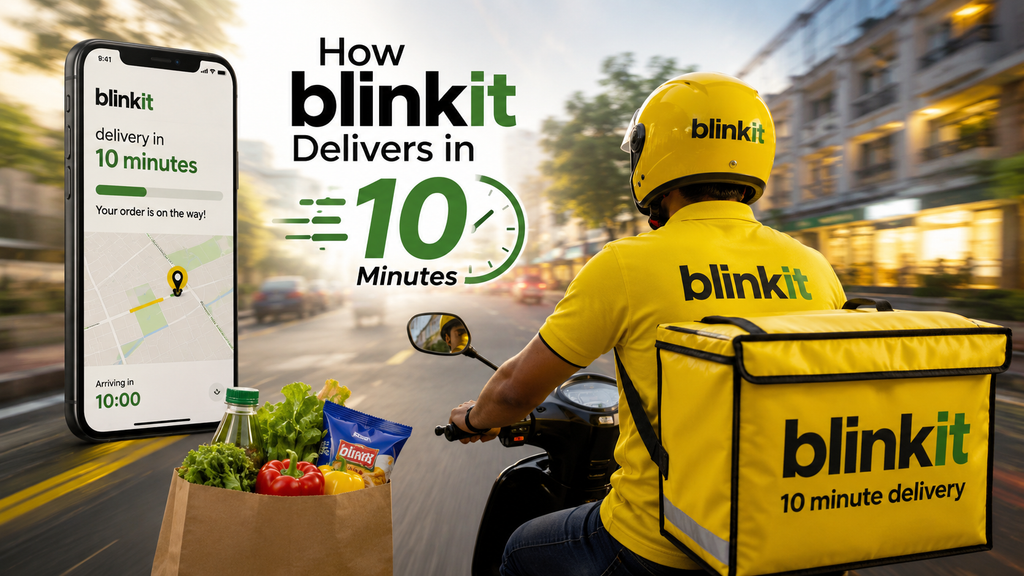
The 10-minute experience is created through several connected processes rather than one single technology.
1. Inventory Is Positioned Near Customers
The first requirement for rapid delivery is proximity.
Blinkit places frequently purchased products inside neighborhood dark stores. Instead of waiting for an item to travel from a central warehouse after an order is placed, the product is already available close to the customer.
This approach is known as hyperlocal inventory positioning and is one of the most important elements of the Blinkit dark store model and the wider Blinkit supply chain.
2. Products Are Organized for Fast Picking
Inside a dark store, shelf organization is designed around operational efficiency. High-demand products can be positioned so employees can locate and pick them quickly.
When an order arrives, the objective is not to browse through shelves like a conventional shopper. The dark store functions more like a streamlined micro-fulfillment center, where every movement is optimized around order processing.
This reduces the time required for picking and packing before the order reaches a delivery partner.
3. Local Demand Influences Inventory
Blinkit cannot stock every product in every location. Instead, inventory decisions need to reflect the buying behavior of individual neighborhoods.
Demand forecasting and historical purchasing data can help determine which products should be available at particular locations. Factors such as time of day, seasonality, local preferences, and previous orders can influence inventory planning.
This data-driven inventory management helps reduce situations where customers search for products that are unavailable nearby.
4. Technology Connects Orders, Inventory and Delivery
The Blinkit app is only one part of the technology ecosystem.
Behind an order are systems responsible for identifying product availability, directing the order to an appropriate fulfillment location, coordinating picking, and supporting delivery operations.
Real-time inventory information, demand forecasting, automated dispatch, and route optimization can work together to reduce unnecessary delays. This is where Blinkit logistics becomes more than simply moving a package from point A to point B.
5. Last-Mile Delivery Covers a Short Distance
Once an order is packed, the delivery journey is intentionally short.
Because dark stores are located within local service areas, delivery partners generally do not need to travel long distances to reach customers. Shorter routes make it easier to maintain rapid delivery times, particularly in dense urban areas.
This combination of dark stores + local inventory + optimized picking + last-mile delivery is the core reason the Blinkit dark store model can operate at such a different speed from traditional e-commerce.
Why Dark Stores Matter for Brands and Sellers
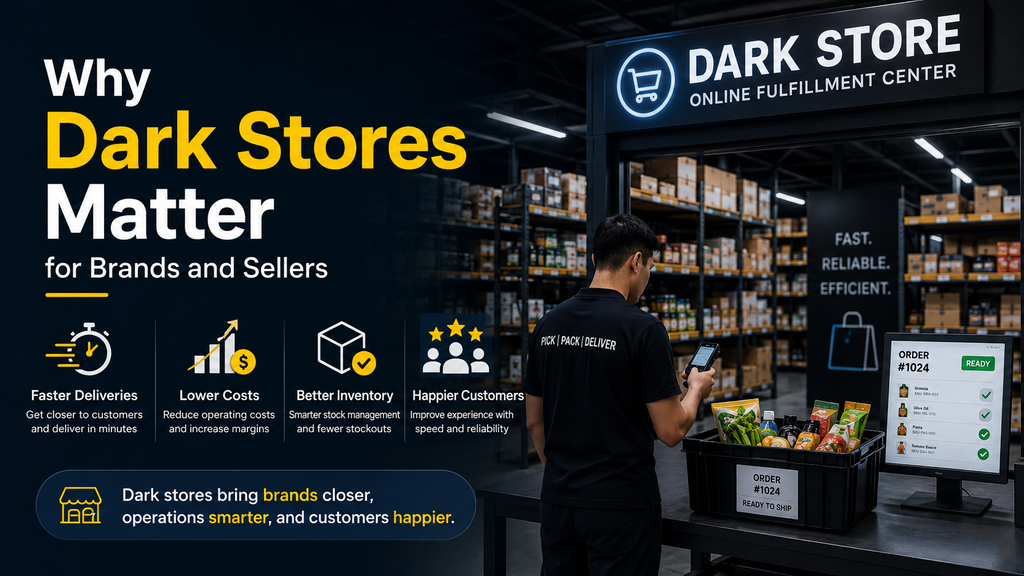
The Blinkit dark store model is important not only for consumers but also for brands entering quick commerce.
For a brand, being available at the right location can influence whether a customer sees the product as an option in the first place. If inventory is not available in a particular service area, a product may miss potential demand even when the brand has sufficient stock elsewhere.
Therefore, brands need to think beyond simply getting listed.
They need to consider inventory planning, product availability, catalog accuracy, pricing, promotions, replenishment, and marketplace performance.
For D2C and FMCG brands especially, quick commerce can create opportunities to capture impulse purchases and urgent-need purchases. But successful execution requires consistent operational management.
How Sellers Can Prepare for Blinkit
Brands that want to sell products through Blinkit should focus on:
- Maintaining accurate product information and catalog data
- Ensuring sufficient inventory for high-demand locations
- Preparing products according to platform requirements
- Monitoring stock availability and replenishment
- Optimizing product images and descriptions
- Tracking sales and product performance
- Planning promotions based on customer demand
- Expanding systematically across relevant locations
This is where professional marketplace management can make a difference.
Grow Your Brand on Blinkit With SalesStrive
Getting listed on a quick-commerce platform is only the beginning. Brands need the right onboarding, catalog management, inventory coordination, listing optimization, and ongoing marketplace support to build sustainable sales.
SalesStrive helps brands navigate e-commerce and quick-commerce operations with expert support, so business owners can focus on growing their products while their marketplace activities are managed systematically.
If you’re planning to enter Blinkit or expand your existing quick-commerce presence, professional account management can help you avoid operational gaps and identify growth opportunities.
Ready to take your brand to the next level? Connect with SalesStrive and explore the right strategy for your Blinkit growth.
Frequently Asked Questions
1. What is the Blinkit dark store model?
The Blinkit dark store model uses compact fulfillment locations dedicated to online orders. These stores keep products close to customers so orders can be picked, packed, and dispatched quickly.
2. How does Blinkit deliver in 10 minutes?
Blinkit combines strategically located dark stores, local inventory, fast order fulfillment, technology-enabled operations, and short last-mile delivery routes to support rapid delivery.
3. What is a dark store in quick commerce?
A dark store is a warehouse-like fulfillment location designed specifically for online orders. Unlike a traditional retail store, customers generally do not visit the location to shop.
4. How does Blinkit manage inventory?
Blinkit’s quick-commerce operations rely on localized inventory planning and data-driven demand forecasting. Products can be stocked according to local purchasing patterns, helping improve availability and fulfillment efficiency.
5. Can brands sell products through Blinkit?
Yes. Brands can explore Blinkit as a quick-commerce channel, subject to the platform’s onboarding, product, operational, and commercial requirements. Sellers should evaluate inventory, catalog, pricing, and fulfilment readiness before expanding.
6. How can SalesStrive help brands with Blinkit?
SalesStrive can support brands with marketplace operations such as onboarding, catalog management, listing optimization, and ongoing account management. This can help brands build a more structured approach to quick-commerce growth.
Conclusion
The Blinkit dark store model demonstrates how modern quick commerce depends on much more than fast delivery riders. The real advantage comes from putting inventory closer to customers and connecting it with efficient fulfillment, demand forecasting, technology, and last-mile logistics.
A customer may see only a few taps on an app, but behind those taps is a highly coordinated supply chain. As explained by SalesStrive in its analysis of Blinkit’s supply chain strategy, dark stores play a crucial role in making this rapid fulfillment possible.
As quick commerce continues to expand in India, dark stores are likely to remain an important part of how brands reach consumers faster. For sellers, this creates a new opportunity—but also increases the importance of inventory planning, product availability, listing quality, and marketplace management.
In short, the Blinkit dark store model powers 10-minute delivery through proximity, precision, technology, and operational execution working together.
 hello@salesstrive.in
3 Responses