
How Blinkit’s Supply-Chain Strategy Is Driving Growth and Better Margins
Quick commerce has changed what Indian consumers expect from online shopping. Instead of waiting for next-day delivery, customers increasingly want everyday products delivered within minutes. Behind this speed is not just a delivery fleet—it is a highly coordinated quick commerce supply chain built around local inventory, dark stores, demand forecasting, and rapid order fulfillment.
Blinkit is one of the strongest examples of this model. Its growth strategy increasingly depends on getting the right products closer to customers, improving inventory efficiency, and increasing the number of orders each fulfillment location can handle. Its move toward an inventory-led business model has also changed how its revenue is reported, making the supply chain an even more important part of its operating strategy.
For brands, understanding how Blinkit supply chain works is equally important because product availability, replenishment, visibility, and operational execution can directly influence sales.
How Does Blinkit Manage Its Supply Chain?
Blinkit’s supply-chain strategy is based on bringing inventory closer to customers through a network of local fulfillment points, commonly known as dark stores. Instead of shipping every order from a large central warehouse, products are positioned closer to the areas where demand exists.
This hyperlocal supply chain strategy reduces the distance between inventory and customers. When an order arrives, the product can be picked, packed, and handed over for last-mile delivery quickly.
The model depends on several connected activities:
- Demand forecasting
- Local inventory planning
- SKU-level stock monitoring
- Dark-store operations
- Replenishment planning
- Rapid order fulfillment
- Last-mile delivery
This combination helps Blinkit maintain delivery speed while serving high-frequency customer demand.
The Role of Dark Stores in Blinkit’s Growth
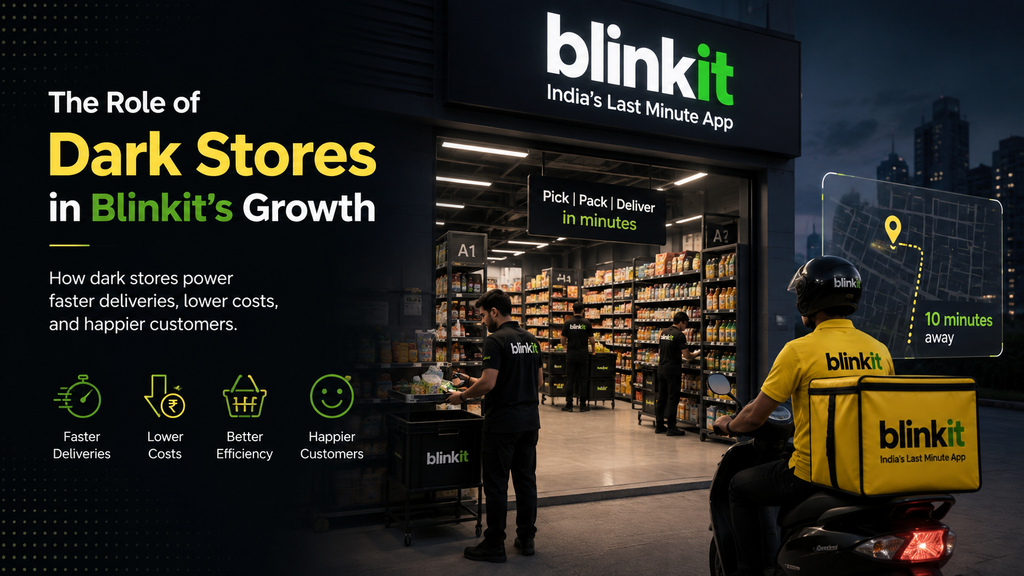
Dark stores are central to understanding how Blinkit dark stores work. These locations are designed primarily for online order fulfillment rather than conventional walk-in shopping.
Their proximity to customers allows brands and platforms to keep popular products within short delivery distances. The result is faster picking and shorter last-mile routes.
However, simply adding more dark stores does not automatically create profitability. Each location needs the right product assortment, sufficient demand, efficient picking processes, and effective inventory turnover.
For this reason, Blinkit’s growth is closely connected to how efficiently it can use its growing store network.
Why Inventory Management Matters on Blinkit
One of the biggest challenges in quick commerce is maintaining stock availability without holding excessive inventory.
If a popular product goes out of stock, the customer may immediately choose another brand. At the same time, keeping too much slow-moving inventory can increase working-capital pressure and operational costs.
Effective Blinkit inventory management therefore requires brands to monitor:
- Fast-moving SKUs
- Local demand patterns
- Seasonal demand
- Stockout frequency
- Replenishment cycles
- Inventory turnover
- Promotional demand
Seller Rocket similarly highlights demand forecasting, fast-moving SKUs, inventory availability, and coordination with supply networks as important elements of Blinkit sales performance.
How the Inventory-Led Model Can Support Growth
Blinkit’s transition from a marketplace model toward an inventory-led model is an important part of its recent business evolution.
Under the earlier marketplace structure, revenue recognition primarily reflected commissions. With the inventory-led approach, the company records the value of goods sold differently, creating a significant change in reported revenue. INDmoney notes that Blinkit’s reported growth therefore needs to be viewed alongside like-for-like performance rather than headline revenue alone.
The broader operational benefit is that greater control over inventory and fulfillment can potentially improve procurement, assortment planning, and supply-chain coordination.
This is important because quick-commerce profitability depends on more than increasing order volume. The business needs to improve unit economics, operational efficiency, inventory utilization, and fulfillment productivity as it scales.
How Blinkit’s Supply Chain Supports Faster Delivery
Speed comes from reducing friction at multiple stages of the order journey.
A simplified process looks like this:
Customer order → Local inventory confirmation → Picking → Packing → Rider allocation → Last-mile delivery
When inventory is already positioned near the customer, the fulfillment process can begin immediately. This is why how Blinkit achieves fast delivery is closely connected to inventory placement rather than delivery speed alone.
Better demand forecasting can also help determine which products should be stocked at particular locations. This reduces unnecessary movement between locations and improves local availability.
Supply-Chain Efficiency and Blinkit’s Margin Story
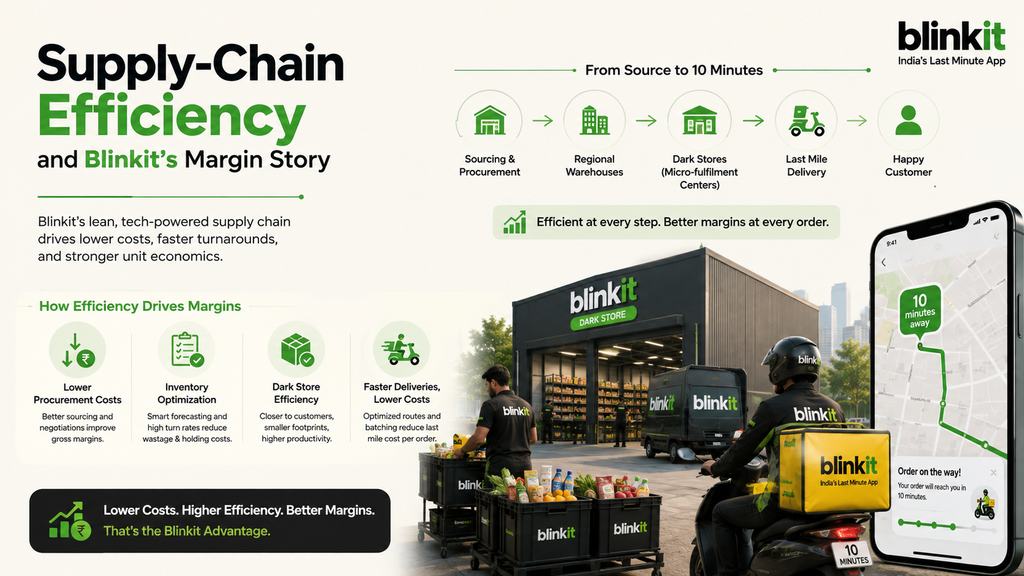
Growth and profitability are two different challenges.
Blinkit has continued to expand rapidly, but its margins remain an important metric to watch. INDmoney reported Adjusted EBITDA of ₹37 crore for the quarter discussed in its analysis, translating to approximately a 0.3% margin. The same analysis notes management’s longer-term ambition of reaching 5–6% EBITDA margins.
This shows why Blinkit supply chain efficiency matters.
As the business scales, better procurement, higher inventory productivity, efficient dark-store operations, increased order density, and optimized delivery routes can help improve economics over time.
The objective is not simply to deliver faster. It is to deliver faster while making every part of the fulfillment process more productive.
What Brands Can Learn From Blinkit’s Supply-Chain Strategy
Blinkit’s model offers several practical lessons for brands entering quick commerce.
First, availability is critical. A great product cannot generate sales if it is consistently unavailable.
Second, brands need location-level demand insights. Customer behaviour can vary significantly between markets, making localized inventory planning valuable.
Third, product assortment matters. Brands should identify fast-moving SKUs instead of treating every product equally.
Finally, marketplace growth requires continuous optimization. Listing quality, pricing, promotions, inventory, advertising, and fulfillment must work together.
For brands wondering how to sell products on Blinkit, getting onboarded is only the beginning. Long-term performance depends on maintaining availability and building an efficient operating strategy.
Why Supply Chain Will Define the Next Phase of Quick Commerce
India’s quick-commerce market is moving from a pure speed race toward a broader efficiency race. Delivery time remains important, but sustainable growth increasingly depends on inventory productivity, store economics, procurement, assortment, and profitability.
Blinkit’s supply-chain strategy demonstrates this shift. Its dark-store network, hyperlocal fulfillment approach, inventory management, and evolving inventory-led model show how operational infrastructure can become a competitive advantage.
For brands, the lesson is simple: quick-commerce success is not only about being listed—it is about being available, discoverable, competitively positioned, and operationally ready to fulfill demand.
FAQ
1. How does Blinkit supply chain work?
Blinkit uses a hyperlocal fulfillment approach where products are positioned close to customers through dark stores. Orders can then be picked and dispatched quickly for last-mile delivery.
2. How does Blinkit manage inventory?
Blinkit’s model depends on localized inventory planning, demand forecasting, SKU monitoring, replenishment, and maintaining product availability across fulfillment locations.
3. Why are dark stores important for Blinkit?
Dark stores allow inventory to be positioned closer to customers, reducing fulfillment and delivery distances and supporting rapid order processing.
4. What is Blinkit’s inventory-led business model?
Blinkit has moved from a traditional marketplace structure toward an inventory-led model. This changes how goods sold and revenue are recorded and gives the business greater operational control over inventory and fulfillment.
5. How can brands increase sales on Blinkit?
Brands should focus on product availability, accurate listings, competitive pricing, demand planning, promotions, advertising, and continuous performance optimization.
6. Can SalesStrive help brands sell on Blinkit?
Yes. SalesStrive can support brands with Blinkit onboarding, product catalog management, inventory planning, marketplace operations, and growth-focused strategies to improve their quick-commerce presence.
Conclusion:
Blinkit’s success shows that quick-commerce growth is not driven by delivery speed alone. Inventory availability, dark-store fulfillment, demand forecasting, product visibility, and efficient marketplace management all play an important role in building sustainable sales.
For brands, simply getting listed on Blinkit is only the first step. To compete effectively, businesses need the right product assortment, optimized catalogs, consistent stock availability, competitive positioning, and continuous performance monitoring.
 hello@salesstrive.in
One Response