How Quick Commerce Apps Make Money: Business Model Explained
Introduction
Quick Commerce has changed the way people shop online by enabling 10–30 minute delivery of daily essentials. From groceries and snacks to medicines and household items, customers now expect instant service with just a few taps.
This growth is driven by platforms like Blinkit, Zepto, and Swiggy Instamart, which are rapidly expanding across urban markets in India.
But the real question is: how do quick commerce companies actually generate revenue when delivery is so fast and operationally expensive?
The answer lies in a multi-layered quick commerce business model built for scale, data, and high order frequency rather than immediate profit.
What is Quick Commerce?
Quick Commerce is an advanced form of e-commerce focused on ultra-fast delivery using a hyperlocal delivery system supported by dark stores. These are small warehouses placed within cities to enable instant dispatch of orders.
Unlike traditional e-commerce platforms such as Amazon or Flipkart that take days for delivery, quick commerce focuses on instant delivery apps in India offering service within minutes.
The biggest difference lies in speed, inventory strategy, and customer expectation. While e-commerce focuses on variety, quick commerce focuses on essential daily-use products delivered instantly through optimized logistics systems.
Core Business Model of Quick Commerce Apps
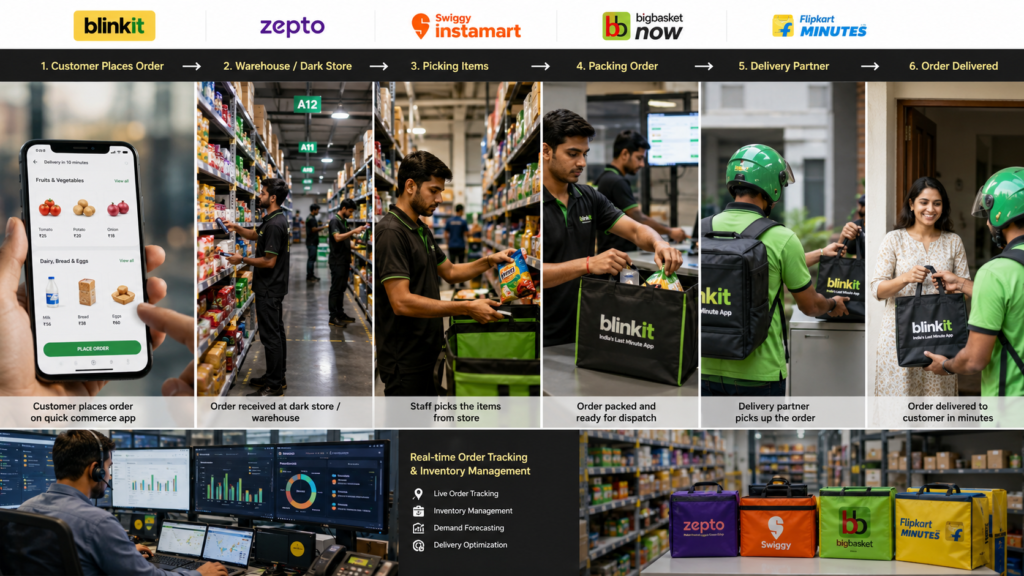
The foundation of the quick commerce ecosystem is a hyperlocal supply chain model powered by technology and automation.
When a customer places an order, it is routed to the nearest dark store. The product is packed instantly and assigned to a delivery partner for immediate dispatch. This entire process is optimized using last mile delivery optimization systems and AI-based demand forecasting tools
This model is designed for high-frequency orders. Even though the profit per order is small, companies depend on scaling unit economics in quick commerce to achieve profitability over time.
Major Revenue Streams
Quick commerce platforms follow multiple revenue channels instead of relying on a single income source.
Product Margin Strategy
One of the primary income sources is the small margin added to each product. This ecommerce pricing strategy ensures that even a slight markup becomes significant when millions of orders are processed daily.
Delivery Charges
Delivery fees form another important revenue stream. Customers are often charged based on order size, urgency, or location. Free delivery thresholds are used to increase average cart value while maintaining delivery fee revenue model balance.
Brand Partnerships and Commissions
Fast-moving consumer goods (FMCG) brands pay platforms for better visibility and placement. This includes featured listings, homepage banners, and priority ranking in search results. This is a strong example of a commission-based marketplace model used in quick commerce platforms.
Subscription and Membership Plans
Many platforms offer premium memberships where users receive free delivery, faster service, and exclusive discounts. This creates a subscription-based ecommerce revenue model that ensures recurring income and customer loyalty.
In-App Advertising Revenue
Quick commerce apps also act as digital advertising platforms. Brands pay for sponsored listings, banner ads, and promotional visibility inside the app. This is part of the growing retail media network trend in ecommerce apps.
Unit Economics Challenges
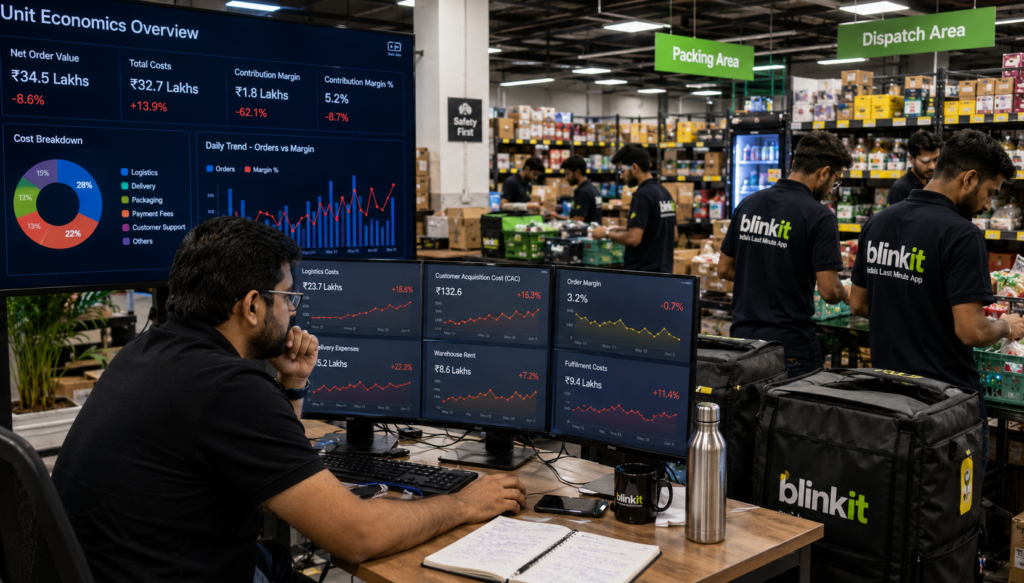
Despite strong growth, quick commerce faces major challenges in profitability. The biggest issue is negative unit economics per order, where operational cost is higher than revenue in early stages.
Major expenses include dark store rent, delivery partner incentives, fuel costs, and inventory wastage. These factors create a heavy startup burn rate in delivery-based ecommerce models.
However, companies aim to achieve profitability through scale, automation, and improved hyperlocal delivery efficiency combined with data-driven decision systems.
Technology and Data Advantage
Technology plays a critical role in the success of quick commerce platforms. AI-based systems help predict demand patterns and optimize inventory levels inside dark stores.
Route optimization algorithms reduce delivery time and cost, while customer behavior analytics improve personalized recommendations. These systems support a strong data-driven retail strategy in instant delivery platforms.
The use of automation and machine learning is gradually improving efficiency and reducing operational losses.
Future of Quick Commerce
The future of quick commerce is expected to expand beyond metro cities into Tier 2 and Tier 3 regions. With increasing digital adoption, instant delivery ecosystem growth in India is expected to rise significantly.
Companies are also diversifying into categories like pharmacy, electronics, and fashion essentials. The industry is moving toward retail automation and fully optimized hyperlocal logistics systems.
Over time, consolidation among major players is expected, leading to a more structured and profitable market.
Conclusion
Quick commerce is not just a delivery system—it is a multi-revenue business model combining product margins, delivery fees, advertising, and subscription-based income streams.
Companies like Blinkit, Zepto, and Swiggy Instamart are building a future where speed, data intelligence, and scalable logistics systems define profitability in the ecommerce industry.
Even though early-stage losses exist, the long-term goal is to dominate the hyperlocal retail and instant delivery market through efficiency and technology.
FAQs–How Quick Commerce Apps Make Money: Business Model Explained
1. Is quick commerce profitable in India?
Most companies are still scaling and focusing on long-term profitability through improved unit economics and automation.
2. How do quick commerce apps earn money?
They earn through product margins, delivery charges, advertising revenue, and subscription plans.
3. Why is quick commerce growing so fast?
Because of increasing demand for instant delivery and urban lifestyle convenience.
4. What is a dark store?
A dark store is a small warehouse designed for fast order fulfillment in hyperlocal areas.
5. What products sell most in quick commerce apps?
Groceries, beverages, snacks, dairy, and daily essentials.
6. Will quick commerce replace e-commerce?
No, it will complement traditional e-commerce for urgent needs.
 hello@salesstrive.in
3 Responses