Introduction
The consumer behaviour pattern has evolved at an incredible pace. The modern-day consumers demand immediacy and convenience. Waiting for 2-3 days to get their order delivered seems to be unacceptable for some consumers, especially in urban cities.
Such consumers demand haves led to the evolution of quick commerce, which is a new stage of e-commerce that aims to deliver goods in 10-30 minutes. Companies such as Blinkit, Zepto, and Swiggy Instamart are revolutionizing the shopping experience for daily items.
Quick commerce is gaining tremendous popularity across India and other parts of the world. In this blog post, we will discuss quick commerce, its functioning, its growth trend, benefits, obstacles, and the future perspective.
What is Quick commerce?
Quick commerce is an instant delivery system where products are delivered very quickly, usually in 10 minutes to 1 hour. This type of service contrasts with conventional eCommerce, which provide various products but delivers them after some times. Quick commerce places greater emphasis on delivering products at rapid speed and at a convenient time for consumers.
Dark stores, which are small warehouses situated in local neighbourhoods, are instruments in achieving fast delivery in quick commerce. They enable businesses to stock products in close proximity to customers.
In essence, quick commerce entails delivering products instantly.
The operation of Quick commerce
While it appears to be easy, quick commerce requires a sophisticated operational system to work effectively.
It usually involves the following steps:
• A consumer makes an order via an app
• The software determines the closest dark store, which is usually within 2 to 3 kilometres
• The goods are picked and packed by store employees
• An order delivery partner is selected immediately
• Goods are delivered promptly
The key lies in three aspects of operations:
1.Dark stores:
These are mini warehouses strategically placed to hold fast-moving goods.
2.Last Mile Logistics:
Order delivery partners deliver orders quickly through optimized routes.
3.Technology & Data:
Software algorithms estimate demands, controls inventories, and optimize routes in real-time.
Key Features of Quick commerce
What distinguishes quick commerce from other online retails models?
• Extreme speed of delivery: Orders delivered in 10-30 minutes
• A limited product selection: Sale of popular high-demand goods
• Localized approach: Storage near consumers locations
• Mobile experience: Ordering via smartphones applications
• Convenience: Perfect solution for emergency needs
Frequent ordering but small quantities
All these aspects provide numerous benefits of quick commerce for city consumers.
Market Trends and Development
Quick commerce is booming nowadays. This model is actively used by consumers in India as a way of making e-grocery purchases.
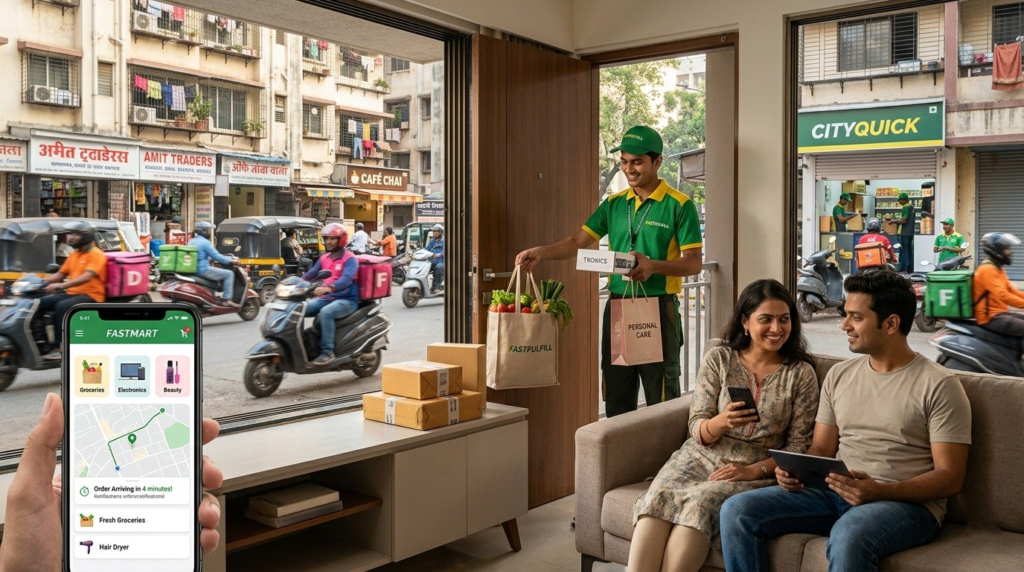
Such rapid development of the quick commerce sectors can be attributed to:
• New lifestyles: Convenience prevails over planning
• Popularity of smartphones: Easy access to applications
• On-demand approach: Emergency of more instant product
In the next several years, the quick commerce market will see millions of users.
As the number of users grows, there is also an increase in the intensity of competition among players such as Blinkit, Zepto, and Swiggy Instamart.
Category expansion: Going beyond food and beverage products into other categories such as electronics, health & beauty goods, and fashion.
Advantages of Quick Commerce
Some of the advantages of quick commerce include:
• Time efficiency: No need for physical store visits
• Convenience: Availability of items when required
• Enhanced customer experience: Increased speed and convenience
• Frequent ordering: Many smaller orders are made by customers
• Impulse purchasing: Encourages impulsive buying
It presents opportunities for businesses to improve customer engagement and loyalty.
Challenges and Limitations of Quick Commerce
While quick commerce has seen significant growth, there are some major challenges:
• Expensive operations: High costs of maintaining dark stores and delivery systems
• Low profit margins: High delivery speed drives up delivery costs
• Urban reliance: Best suited for urban centres
• Scalability problems: Hard to scale to Tier 2 and Tier 3 cities
• Workforce challenges: Delivery schedules may put undue pressure on employees
• Sustainability issues: Frequent deliveries affect the environment
Quick Commerce and Traditional eCommerce Difference
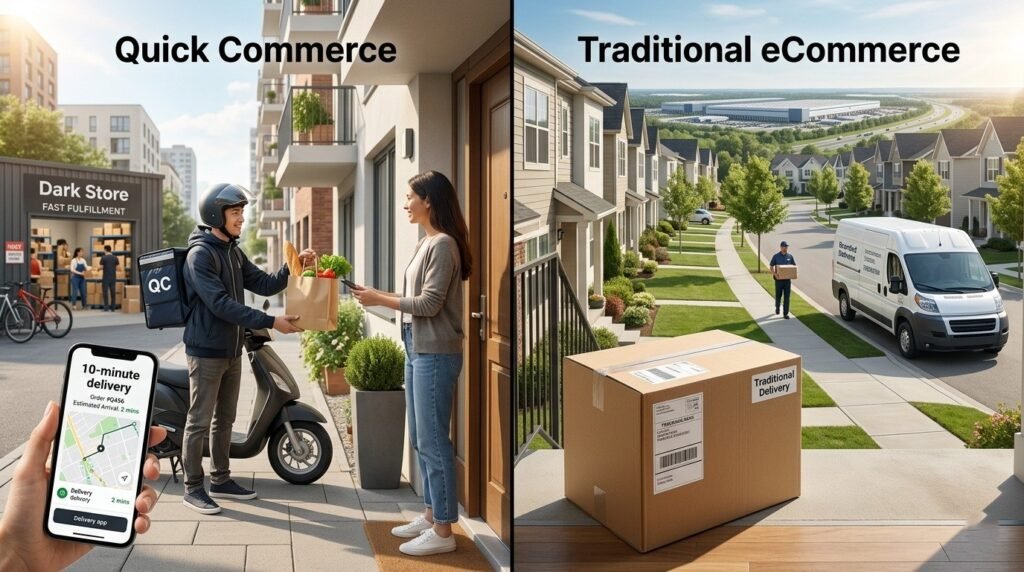
The following table explains the difference between Quick ecommerce and traditional eCommerce models:
Quick commerce Traditional eCommerce
Fast delivery (minutes) Faster delivery (hours to days)
Limited product selection Vast selection
Small basket size Large basket size
Nearby hyperlocal warehouses Centralized warehouses
Instantaneous needs Purchased items
In place of replacing traditional eCommerce, quick commerce is used as a supplementary model for meeting instant needs.
Future of Quick Commerce
The future of quick commerce is bright but demands evolution.
Important changes that need to be taken note of:
• Moving into Tier 2 cities
• New product category like electronics and apparel
• Local kirana stores integration
• Logistics from ‘10 minutes delivery’ to a sustainability time schedule
Some firms, such as Delivery Hero, have invested heavily in creating a Quick Commerce ecosystem.
In the coming years, it is essential to balance speed, profits, and sustainability.
Ways in Which SalesStrive Will Boost Your Quick Commerce Business
As the quick commerce sector continues to expand at a rapid pace, brands are no longer required to focus merely on timely delivery; they are expected to build their online presence,
adopt effective promotional strategies, and ensure customer reach. These are the areas in which SalesStrive will help your business thrive.
Through comprehensive solutions relating to product promotions and digital marketplace marketing, SalesStrive ensures that customers become more engaged, achieve higher visibility, and generate better conversion rates through modern commerce platforms.
Whatever it is that you wish to enhance concerning quick commerce platform promotion or digital customer acquisition, SalesStrive has a solution to help you remain competitive in the fast-paced world of retail commerce.
Conclusion
The emergence of quick commerce has revolutionized shopping for people in their quest for speed and convenient. Indeed, it has revolutionized the expectations of consumers, who now demand immediate deliveries.
The model must overcome various difficulties in order to be successful in the future in terms of cost-effectiveness, scalability and sustainability.
What can be stated is that quick commerce is far more than just a trend. It has evolved into an integral part of current day retailing practices.
FAQs
1.What does quick commerce mean?
It is a type of delivery goods within a span of 10-30 minutes, mainly concentrating on daily necessities.
2.Why is quick commerce different from eCommerce?
Quick commerce emphasizes speed rather than variety and pricing, which are key concerns in the eCommerce domain.
3.Who are some popular quick commerce firms operating in India?
They include Blinkit, Zepto, and Swiggy Instamart.
4.Is Quick Commerce profitable?
It is difficult to make quick commerce profitable due to the associated high cost of delivery and operations.
5.What kinds of items are there in quick commerce?
Mainly groceries, snacking foods, medications, and essential household needs.
 hello@salesstrive.in