Quick Commerce Advertising in India: Blinkit, Zepto & Instamart Ads Cost, ROAS, and Strategies
Quick commerce advertising in India is now one of the fastest modes for D2C brands and FMCG brands to reach the shopper precisely at the point of purchase. The growth is proof. Zepto’s draft IPO filings indicated advertising revenue of ₹1,635.7 crore for FY26, a year-over-year increase of approximately 151%, generated from 2,468 advertising brands.
This buyer’s guide from the SalesStrive team covers the pricing of Blinkit ads, Zepto ads, and Instamart ads; the expected ROAS from these ads; and our techniques for ensuring each campaign remains profitable.
What Is Quick Commerce Advertising in India?
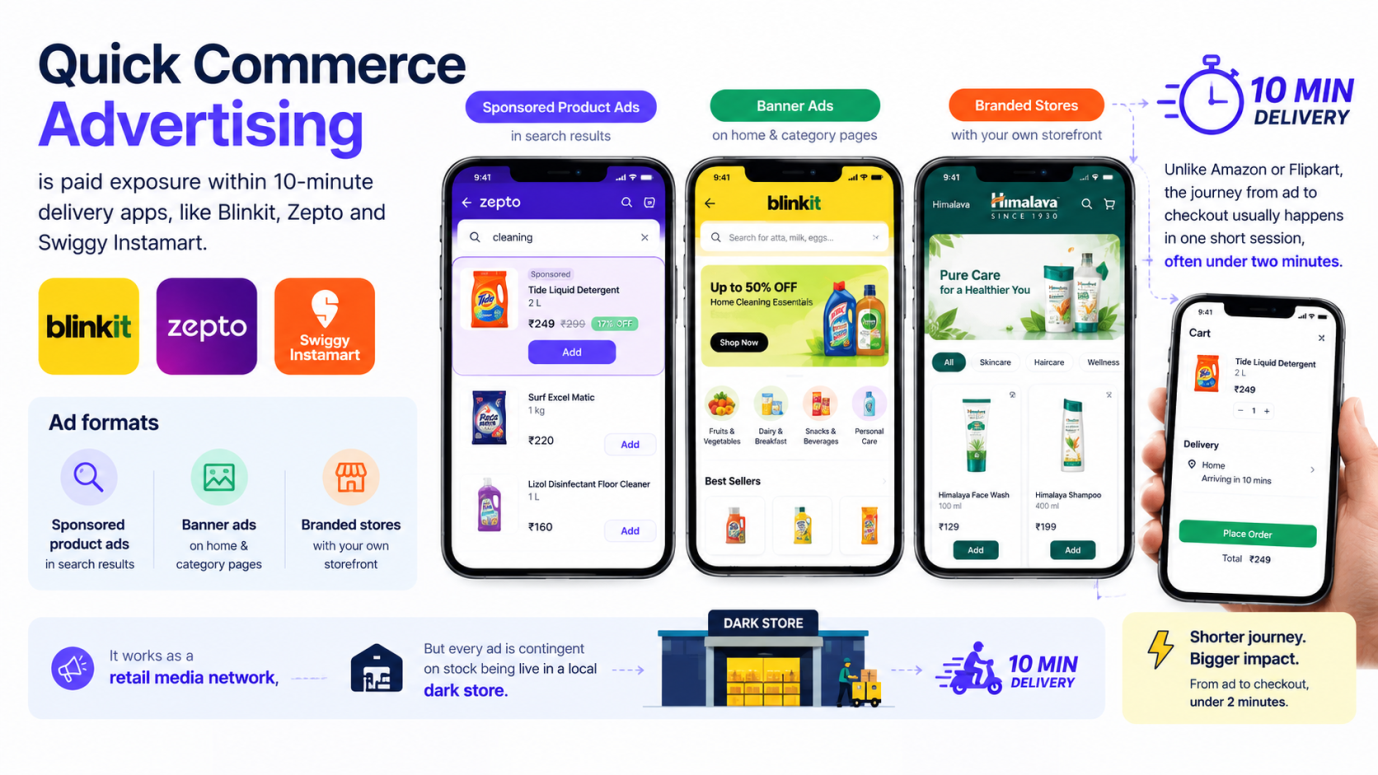
Quick commerce advertising is paid exposure within 10-minute delivery apps, like Blinkit, Zepto, and Swiggy Instamart. The advertising is currently centered around sponsored product ads in search results, banner ads on home and category pages, and branded stores. It works as a retail media network, but every ad is contingent on stock being live in a local dark store.
How Are Blinkit, Zepto, and Instamart Ads Priced?
Quick commerce ad costs are determined through real-time auctions. Sponsored search ads are charged per click (CPC), while banners are usually charged per thousand impressions (CPM) or sold as fixed placements.
|
Platform |
Ad Model |
Key Formats |
|
Blinkit ads |
CPC search, CPM banners |
Product Booster, brand banners, category takeovers |
|
Zepto ads |
CPC plus bundled packages |
Sponsored products, homepage banners, Swap and Save |
|
Swiggy Instamart ads |
CPC/CPM plus quarterly packs |
Sponsored listings, banners, push notifications |
None of the three platforms gives an official rate card. Your actual Blinkit advertising cost or Zepto spend varies based on keyword competition, city category, and the number of competitors bidding that week. Before setting a budget, review your margins using our free
What Is a Good ROAS for Quick Commerce Ads?
A good quick commerce ROAS is one that is net profitable after all costs. Commonly cited in platform dashboards is 3x-5x, and Zepto refers to a Redseer estimate of 5x-8x in its prospectus. The net ROAS post-commission and product cost is in fact closer to 1x-2.5x.
Platform ROAS vs. True ROAS
True ROAS = (Net sales at selling price − platform commission − COGS) ÷ Ad spend
Of course, here’s a quick example:
- Ad spend: ₹10,000
- Attributed sales: ₹40 000 with a platform ROAS of 4x.
- Commission at 15%: ₹6,000 COGS at 45%: ₹18,000
- (Actual ROAS): (₹40,000 – ₹6,000 – ₹18,000) ÷ ₹10,000 = 1.6x.
One warning: some dashboards report ROAS based on MRP instead of the actual discounted selling price, causing the figures to appear more attractive. Monitor ACoS, conversion rate, and sales attribution together, and use our Break Even Calculator to determine your minimum profitable ROAS.
Blinkit vs Zepto vs Instamart: Which Is Best for Advertising?
Most brands should begin with Blinkit; Zepto brings cost benefits, and Instamart is appropriate for more mature FMCG brands.
|
Platform |
Key Strength |
Best For |
Unique Format |
|
Blinkit |
Most mature self-serve tools with SKU and city reporting |
New D2C brands testing quick commerce |
Product Booster |
|
Zepto |
Lower CPCs and commission than rivals |
Growing D2C brands ready to scale |
Swap and Save (shown when shoppers add a rival product to cart) |
|
Instamart |
Reach into Swiggy’s food delivery users |
Established FMCG brands |
Quarterly brand packs, push notifications |
What we suggest: D2C brands should try to establish profitability on Blinkit first, while FMCG brands with high recall should be present on Blinkit and Instamart simultaneously.
5 Quick Commerce Advertising Strategies That Improve ROAS
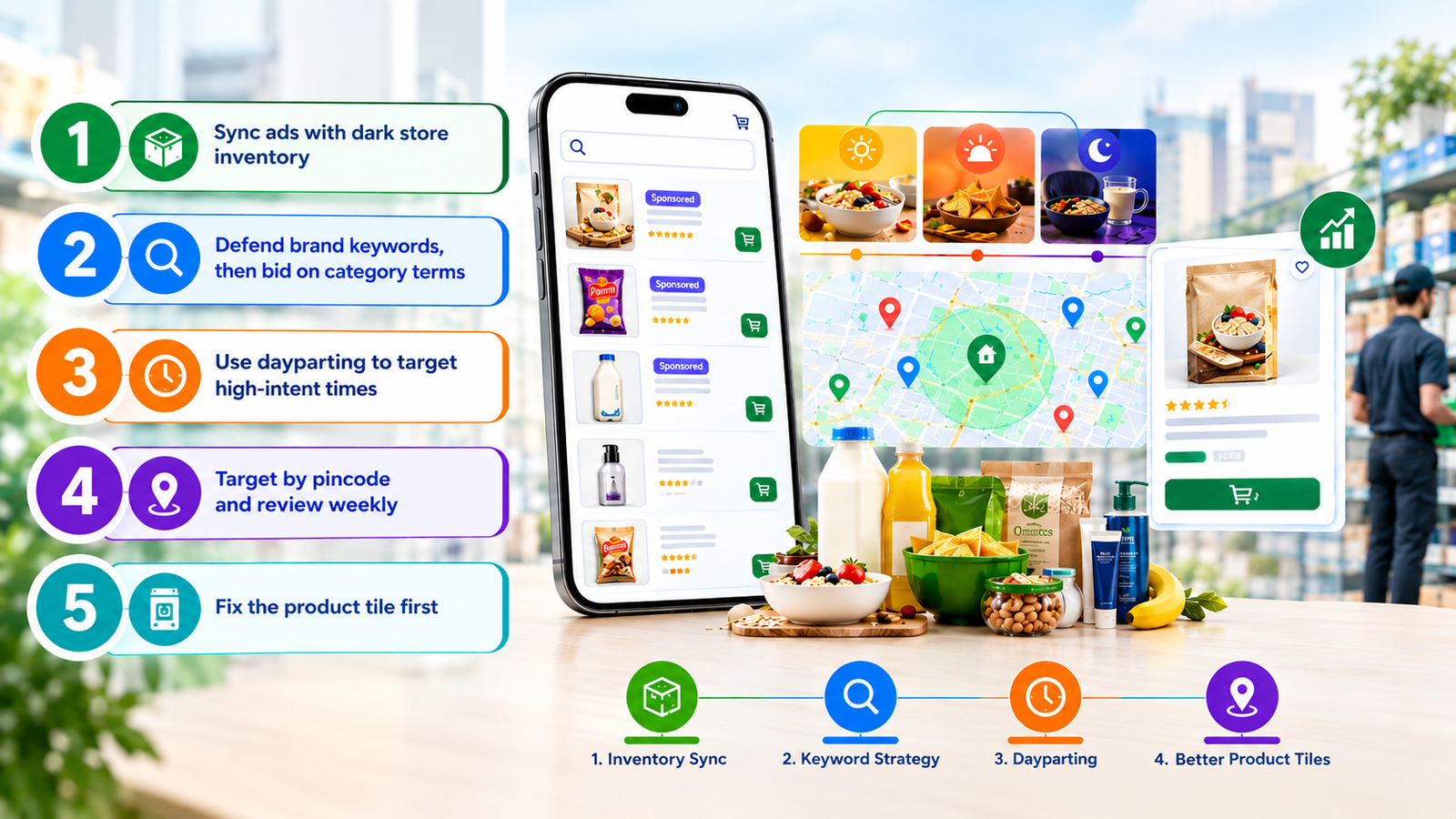
Follow these five steps to have a solid e-commerce marketing plan for 2026.
- Sync ads with dark store inventory ads only convert with stock, so immediately pause campaigns in any pincode where your SKU is out of stock.
- Defend brand keywords, then bid on category terms first, conquer your brand name, then change to bid on keyword bidding on search ads for general terms like “oats” or “face wash” that shoppers have not yet selected a brand for.
- Use dayparting to target high-intent Breakfast searches are concentrated between 6 and 9 AM, snacks are at 5-7 PM, and impulse buys are late at night. All day flat bids are a waste of funds.
- Target by pincode and review weekly. Hyperlocal targeting works best for us when we check ROAS by SKU and city every week, not every quarter.
- Fix the product tile first. A pack image, a title with variant and size, and a competitive price boost add-to-cart rate more than any bid change.
Same checks we do in quick commerce onboarding and account management for brands for all three platforms.
Quick Commerce Ads vs Amazon Ads in India
|
Factor |
Quick Commerce Ads |
Amazon Ads |
|
Shopping session |
Under 2 minutes, impulse-driven |
Longer, research-driven |
|
Catalogue |
Limited to the nearest dark store |
National catalogue |
|
Attribution |
Same session, SKU and city level |
Often spread across days |
Quick commerce wins on speed and impulse buying, while Amazon is stronger for high-consideration products.
Frequently Asked Questions
1. What is quick commerce advertising in India?
It is paid visibility within 10-minute delivery apps such as Blinkit, Zepto, Swiggy, and Instamart. Brands can promote their products through sponsored product ads, banner ads, and brand stores.
2. How are Blinkit ads priced?
Blinkit ads operate through a real-time auction model. CPC (Cost Per Click) applies to sponsored products, while CPM (Cost Per Thousand Impressions) applies to banner ads. Costs vary depending on the city, category, and target keywords.
3. What is a good ROAS for quick commerce ads?
Advertising dashboards commonly show a ROAS of 3x–5x. However, after considering product costs and platform commissions, the actual profitability may be closer to 1x–2.5x.
4. Which quick commerce platform is best for advertising?
Blinkit is a good starting point for brands. Zepto can be suitable for growing D2C brands, while Swiggy Instamart can work well for FMCG brands with prior advertising experience.
5. How do I advertise on Zepto as a new brand?
Start by listing your products through the Zepto brand onboarding process. Once your products are available, launch sponsored product ads for your best-selling or hero SKUs. We also offer a Zepto onboarding service to help brands get started.
6. Why are my quick commerce ads not showing?
One of the most common reasons is product inventory availability. Ads may not appear in locations where your products are not stocked in the nearest dark store. Maintaining sufficient inventory is important for consistent ad visibility.
Conclusion
Quick commerce advertising in India rewards brands that pair smart bidding with tight inventory control and transparent ROAS tracking. Start small, measure true profitability, and scale what works.
Get a Free Blinkit Margin Audit from SalesStrive
SalesStrive helps brands selling on Blinkit, Zepto and Swiggy Instamart with catalogue optimization, advertising and marketplace growth strategies.
 hello@salesstrive.in

Your Trusted Marketplace Growth Partner
Get Your FREE Quick-Commerce Consultation Today!
Amazon | Flipkart | Myntra | Ajio | Meesho | Blinkit | Zepto | Noon | Walmart