How Zepto’s Dark Store Model Powers Quick Commerce in India
Quick commerce has changed how consumers shop for groceries, personal care products, beverages, and everyday essentials. Instead of waiting for traditional ecommerce delivery, customers increasingly expect products to arrive within minutes. Behind this speed is a carefully designed fulfilment network, and the Zepto dark store model is a strong example of how this system works.
A dark store is a micro-warehouse designed exclusively for online order fulfilment. Unlike a traditional retail store, customers do not visit the location. Products are stored, picked, packed, and dispatched directly to nearby customers. Zepto’s model combines this infrastructure with technology, inventory planning, and hyperlocal delivery to support its quick commerce operations.
What Is the Zepto Dark Store Model?
The dark store model focuses on placing inventory close to the customers who are most likely to order it. Zepto uses strategically located fulfilment centres rather than relying only on large warehouses outside cities.
In a typical Zepto dark store, the layout is optimized for fast picking instead of customer browsing. Products are arranged based on demand, order frequency, and operational efficiency. This reduces the time required to locate and prepare an order.
The model is closely connected to hyperlocal fulfilment, where inventory is positioned within a limited delivery radius of the customer. This makes the Zepto delivery model different from conventional ecommerce, where products may travel much longer distances from centralized warehouses.
How Zepto Dark Stores Enable Fast Delivery
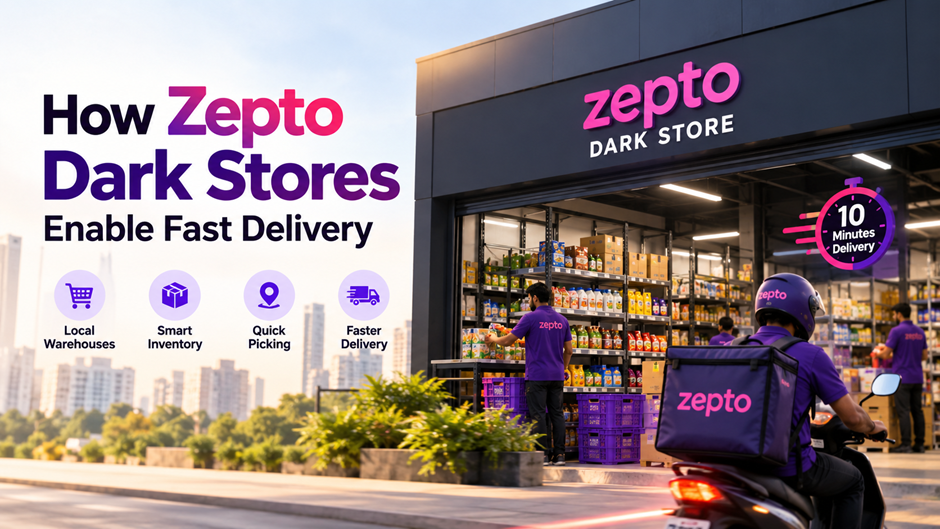
The basic process is simple but highly coordinated:
Customer order → Dark store selection → Order picking → Packing → Rider dispatch → Last-mile delivery
When a customer places an order, the system identifies an appropriate fulfilment location based on factors such as product availability and proximity. Store employees then pick the required items, pack them, and hand the order to a delivery partner.
This explains how Zepto dark stores work and how Zepto dark stores enable fast delivery. The shorter distance between inventory and customers reduces travel time, while organized order picking, rider dispatch, and route optimisation help streamline the final stage.
The broader quick commerce delivery model therefore depends on more than delivery riders. It requires coordinated dark store operations, technology, inventory availability, and last-mile delivery.
How Dark Stores Power Quick Commerce
The main advantage of quick commerce dark stores is proximity. Traditional warehouses are designed to hold large inventories and distribute products across wider regions. Dark stores are smaller and focus on fast-moving products required by customers in a specific area.
This is why dark stores in India have become an important part of the quick commerce business model. A network of smaller fulfilment locations can bring products closer to customers while supporting faster order processing.
The micro warehouse model also allows platforms to organize inventory around local demand. A neighbourhood may have different purchasing patterns from another part of the same city. Demand forecasting, real-time inventory, and localised inventory help platforms respond to these differences.
In practical terms, how dark stores power quick commerce comes down to three factors: keeping popular products nearby, reducing picking time, and shortening the final delivery distance.
The Role of Inventory Management
Speed is only possible when the required product is actually available. This makes dark store inventory management a critical part of the Zepto business model.
Platforms need to understand which products move quickly in individual locations. This involves inventory replenishment, stock availability, SKU planning, and SKU assortment decisions.
Fast-moving products can receive more inventory, while slower products may receive less space. This helps improve the efficiency of each dark store.
For brands, this creates an important lesson: entering quick commerce is not simply about uploading a product catalogue. Brands must understand local demand, maintain inventory, and plan replenishment according to sales velocity.
What the Dark Store Model Means for D2C Brands
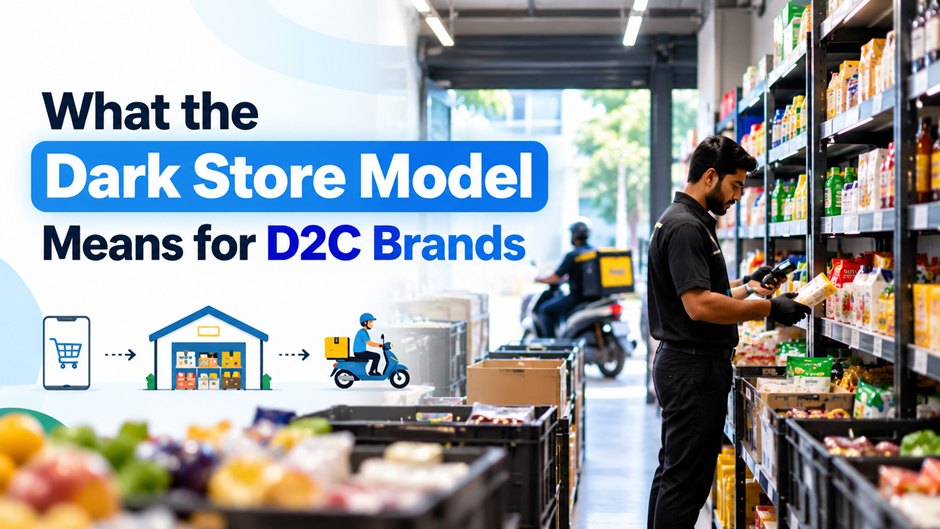
The dark store model for D2C brands creates an opportunity to place products closer to high-intent customers. However, it also creates operational requirements.
A brand entering Zepto quick commerce should consider product selection, inventory availability, packaging, pricing, demand patterns, and marketplace visibility.
This is where dark store fulfilment for D2C brands becomes important. Brands need to coordinate inventory across locations instead of treating the entire country as one market.
For example, a product may perform strongly in one city but move slowly in another. Monitoring fast-moving products, stock availability, and customer catchment areas can help brands make better inventory decisions.
How Brands Can Grow on Zepto
Brands looking at how to sell on Zepto should consider both operational readiness and marketplace visibility. Zepto seller onboarding is only the starting point.
After onboarding, brands need strong Zepto product listing, accurate product information, relevant keywords, quality images, competitive pricing, and consistent inventory.
Zepto product listing optimization can help improve how products are presented to customers. Brands should also monitor Zepto product visibility, sales velocity, availability, and advertising opportunities.
For businesses expanding across quick commerce, Zepto seller management, Zepto marketplace management, and Zepto inventory management for brands can become increasingly complex as the number of products and locations grows.
How Sales Strive Helps Brands
Sales Strive helps brands manage the operational and marketplace requirements involved in quick commerce growth. From Zepto marketplace for brands and Zepto brand onboarding to quick commerce marketplace management and quick commerce seller account management, the focus is on building a structured marketplace presence.
Sales Strive can support product listings, catalogue management, marketplace visibility, advertising, inventory readiness, and growth strategies across platforms such as Zepto, Blinkit, and Swiggy Instamart.
For brands asking how brands can sell on Zepto, the key is not just getting listed. It is maintaining the right products, accurate listings, consistent availability, and a clear quick commerce logistics strategy.
Frequently Asked Questions
How does Zepto dark store model work?
The Zepto dark store model uses compact fulfilment locations positioned close to customer demand. Orders are picked and packed at these locations before being handed to delivery partners.
How does Zepto deliver in 10 minutes?
The model combines nearby inventory, organized order fulfilment, fast picking, technology-enabled dispatch, and short delivery distances. The exact delivery time can vary by location, order, traffic, and operating conditions.
How does the dark store model work in India?
The dark store model in India uses small, city-based fulfilment centres that focus on online orders rather than walk-in shopping. They support rapid picking, packing, and hyperlocal delivery.
How does Zepto manage inventory in dark stores?
Zepto’s operating model uses demand forecasting and inventory systems to determine what products should be available at individual locations. This supports inventory replenishment and reduces the risk of unavailable products.
How do dark stores improve delivery speed?
Dark stores reduce the physical distance between products and customers. Combined with efficient picking and dispatch, this helps support 10-minute delivery and other quick-delivery models.
How can D2C brands benefit from dark stores?
D2C brands can use dark-store networks to place products closer to customers, improve availability, and participate in high-frequency quick commerce shopping. However, success requires strong inventory planning, product selection, and marketplace management.
Conclusion
The Zepto dark store model has become an important part of how quick commerce in India operates. By placing inventory closer to customers, optimizing order fulfilment, and using technology for inventory and delivery management, dark stores help reduce fulfilment time and support faster deliveries.
For D2C brands, understanding the dark store model in India is equally important. Strong product selection, accurate listings, consistent stock availability, and effective Zepto marketplace management can help brands build a stronger presence in the growing quick commerce ecosystem.
 hello@salesstrive.in