The February 2026 U.S. tariffs have created a major shift in the ecommerce landscape. For online sellers, this isn’t just another regulatory headline—it’s a direct hit to profit margins, pricing models, and long-term scalability. With the Supreme Court striking down IEEPA tariffs and the administration implementing a 15% Section 122 surcharge, sellers must now rethink their cost structure and operational strategy.
If you’re an Amazon seller, Shopify brand owner, or cross-border ecommerce entrepreneur, this ecommerce tariff update 2026 could significantly affect your bottom line. The good news? With the right strategy and tools, you can protect your profits—and even gain a competitive advantage.
Let’s break it down clearly and strategically.
What Changed Under the February 2026 U.S. Tariffs?
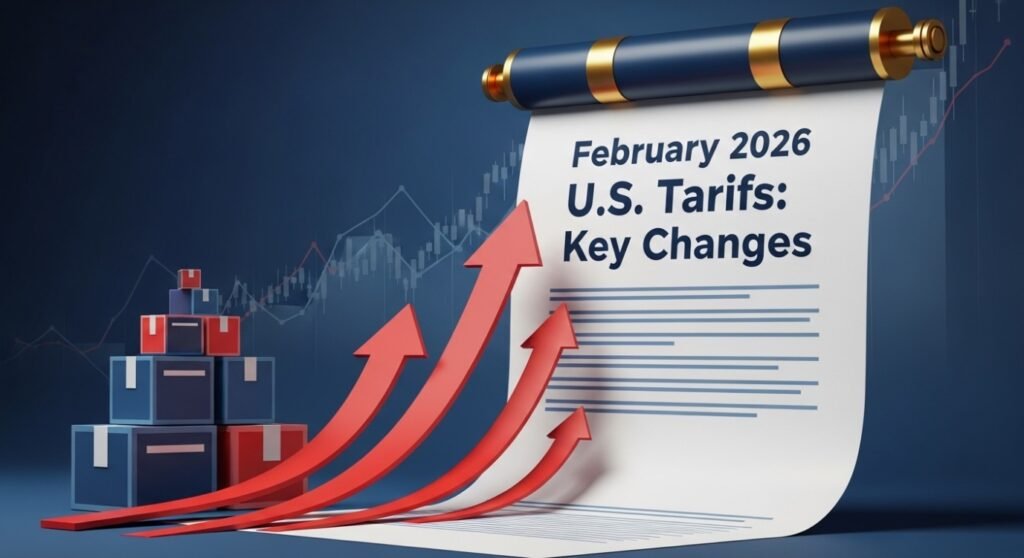
The February 2026 U.S. tariffs introduced two major developments:
- A 15% Section 122 surcharge applied broadly to imports.
- The permanent suspension of the $800 de minimis exemption.
Previously, many sellers relied on the de minimis rule to import low-value shipments without paying duties. That model has now ended.
In addition, the Section 122 surcharge stacks with Section 301 tariffs—particularly impacting sellers sourcing from China. This stacking effect can push total tariff exposure beyond 40% in some cases.
For ecommerce businesses operating on tight margins, that’s a serious concern.
Why Landed Cost Calculation 2026 Is Now Critical
If you don’t know your exact landed cost, you don’t know your real profit.
Under the new structure, sellers must calculate:
Landed Cost = Customs Value × (1 + Base Duty + 15% Section 122 + Section 301) + MPF + HMF + Brokerage + Bond
Additional fees include:
- MPF (0.3464%)
- HMF (0.125% for ocean freight)
- Brokerage charges
- Continuous bond costs
Let’s say you import a product with a $50 customs value and face 25% Section 301 plus 15% Section 122.
That’s 40% before fees.
$50 × 1.40 = $70
After additional fees, your true landed cost may exceed $80.
If you’re still pricing based on 2025 cost structures, you could be losing money on every unit.
This is where many sellers fall behind—they fail to update their pricing strategy in real time.
The End of De Minimis: A Turning Point for Dropshipping
The suspension of de minimis changes everything for cross-border dropshippers.
Now:
- Every shipment requires customs entry.
- Entry Type 86 is eliminated.
- Brokerage and compliance costs apply to all parcels.
Single-item shipments from overseas suppliers are no longer as profitable as before. The cost-per-unit has increased significantly.
Smart sellers are shifting to:
- Bulk importing
- U.S.-based 3PL fulfillment
- Consolidated freight shipments
- Inventory forecasting optimization
The February 2026 U.S. tariffs favor sellers with structured logistics—not fragmented operations.
Hidden Cost Stacking: Shipping and Carrier Increases
Tariffs are only part of the story.
In 2026, carriers introduced:
- General Rate Increases (GRI)
- Higher residential surcharges
- Strict cubic pricing enforcement
When tariffs stack with freight hikes, costs compound quickly.
This “cost stacking” effect makes real-time data and forecasting absolutely essential.
Guesswork is no longer sustainable.
Strategic Actions Ecommerce Sellers Must Take Now
If you want to protect profits, here’s your immediate action plan:
- Audit all HTS classifications.
- Recalculate landed cost calculation 2026 for every SKU.
- Identify low-margin products at risk.
- Re-negotiate supplier contracts.
- Consider domestic warehousing.
- Adjust pricing strategically.
- Monitor the July 24 expiration window for Section 122.
Waiting is not a strategy.
Proactive sellers win in volatile environments.
Why Data-Driven Sellers Will Dominate 2026
Policy shifts create uncertainty—but they also create opportunity.
When competitors fail to adapt, disciplined sellers gain market share.
The key difference? Visibility and control.
You need:
- SKU-level profitability tracking
- Scenario modeling for tariff changes
- Dynamic pricing optimization
- Performance dashboards
- Margin forecasting tools
Manual spreadsheets can’t keep up with this complexity.
That’s where technology becomes your competitive edge.
How SalesStrive Helps You Protect and Grow Profits
Navigating the February 2026 U.S. tariffs requires more than compliance—it requires strategic optimization.
SalesStrive is built to help ecommerce brands adapt, scale, and protect margins in complex environments.
With SalesStrive, you can:
- Instantly model updated landed cost scenarios
- Identify at-risk SKUs under new tariff structures
- Optimize pricing without hurting conversions
- Monitor profit margins in real time
- Forecast performance under multiple cost scenarios
- Make confident, data-driven decisions
Instead of reacting emotionally to tariff changes, you gain clarity and control.
SalesStrive combines performance analytics, profitability insights, and actionable growth strategies into one streamlined system—designed specifically for modern ecommerce businesses.
In an environment shaped by the ecommerce tariff update 2026, the brands that survive won’t be the biggest—they’ll be the smartest.
Final Thoughts: Adapt Early, Win Long-Term
The February 2026 U.S. tariffs mark a significant shift in ecommerce economics. Higher duties, stricter customs requirements, and increasing freight costs are challenging—but manageable with the right systems in place.
Businesses that recalibrate quickly will maintain margins. Those who ignore these changes may struggle.
Now is the time to:
- Calculate accurately.
- Price strategically.
- Optimize operations.
- Leverage technology.
👉 Ready to turn tariff pressure into growth opportunity?
Start using SalesStrive today and protect your ecommerce profits with confidence.